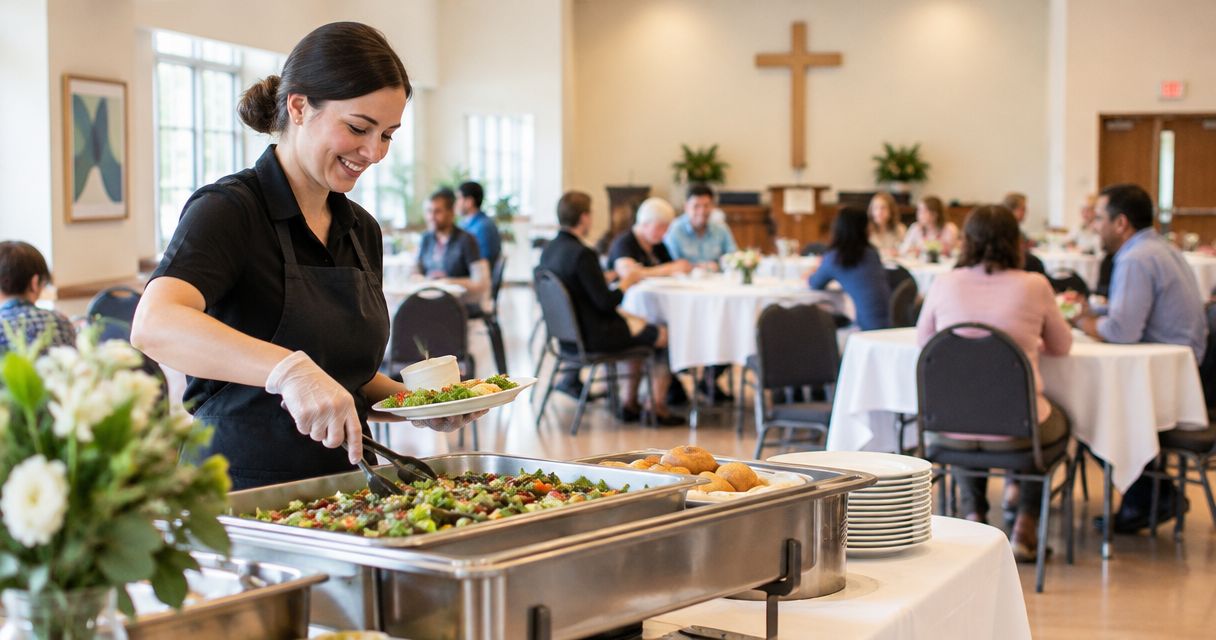
Catering insurance is required for a church fellowship hall when the church’s facility-use agreement or vendor rules require it; the venue type alone does not establish a universal requirement. The church’s own insurance does not automatically cover an outside caterer, and a certificate of insurance does not expand a policy’s coverage. Before your 2026 gathering, get the church’s requirements in writing and have the caterer’s insurance agent confirm that the documents match them.
- Is catering insurance required for a church fellowship hall? Follow the church’s written venue requirements and applicable law.
- A certificate of insurance shows policy information; it does not create additional insured coverage.
- Separate the caterer’s liability coverage from the organizer’s event insurance before signing agreements.
- DG&G Gravy Train Catering serves church gatherings with BBQ and soul food across the Charlotte metro area.
Why this matters
A fellowship meal should bring folks together, not leave the church secretary sorting through insurance paperwork while guests arrive. The useful question is not simply whether a caterer has insurance. It is whether the required coverage applies to the business, work, and event you are arranging.
Settle that question alongside the room reservation and meal plan. The church event catering workflow helps you connect the gathering’s schedule with catering arrangements; keep insurance approval in that same planning file.
Do not treat a menu confirmation as permission to use the fellowship hall. Food arrangements and facility approval are separate decisions.
Is catering insurance required for a church fellowship hall?
Yes, if the church requires it in its facility-use or vendor agreement. There is no single answer that applies to every church hall. Applicable legal obligations also depend on the business and jurisdiction, so the venue agreement is a starting point—not a substitute for legal or insurance advice.
For your 2026 event, distinguish the documents below before asking anyone to purchase coverage. They address different responsibilities and are not interchangeable.
| Document or coverage | Best for | What it addresses | Important limitation |
|---|---|---|---|
| Caterer’s commercial general liability policy | Reviewing the caterer’s business liability coverage | Covered bodily injury and property damage claims, subject to policy terms | Food-related claims, exclusions, and applicable limits need review |
| Certificate of insurance | Giving the church a summary of policy information | Named insured, insurer, dates, and listed limits | Does not change the policy or grant coverage by itself |
| Additional insured endorsement | Addressing a church’s request for insured status under a vendor’s policy | Coverage granted by the endorsement’s actual wording | Does not make every church activity or claim covered |
| Organizer’s special event policy | Addressing the host’s event-specific insurance needs | Coverage selected for the organizer and event | Does not automatically replace the caterer’s insurance |
| Church’s own insurance policy | Reviewing the church’s existing protection | The church’s coverage under its policy terms | Does not automatically insure an independent catering business |
Start with the facility coordinator, church administrator, or person authorized to approve outside vendors. Ask that person to identify the requirements and the person who will accept the paperwork. A volunteer helping with decorations is not necessarily the insurance decision-maker.
What insurance documents should you request?
Use 3 document checks: the church’s requirements, the caterer’s certificate, and any required endorsement. These checks organize the paperwork; they are not a universal list of legally required documents.
The church’s written requirements
Request the current facility-use agreement and any outside-vendor insurance instructions. Ask whether the organizer and caterer have separate obligations. A family renting a hall for a reception can have different responsibilities from a church committee arranging its own fellowship meal.
Get the required wording directly from the church. Do not guess its legal name, coverage limits, submission deadline, or requested endorsements.
The caterer’s certificate of insurance
Ask the caterer to obtain a certificate from its insurance agent for the event review. Check that the named business matches the party providing catering and that the listed policy dates include the event date.
A certificate is useful evidence, but it is not a guarantee that a particular claim will be paid. Send questions about food service, exclusions, or the scope of coverage to the insurance agent rather than interpreting a checked box yourself.
Any required additional insured endorsement
If the church requests additional insured status, have the caterer’s agent address that request. The endorsement’s wording determines the coverage it provides.
Listing a church as a certificate holder is not the same as making it an additional insured. Ask the church’s reviewer what evidence is needed to confirm that its requirement has been met.
How do you get catering insurance approved?
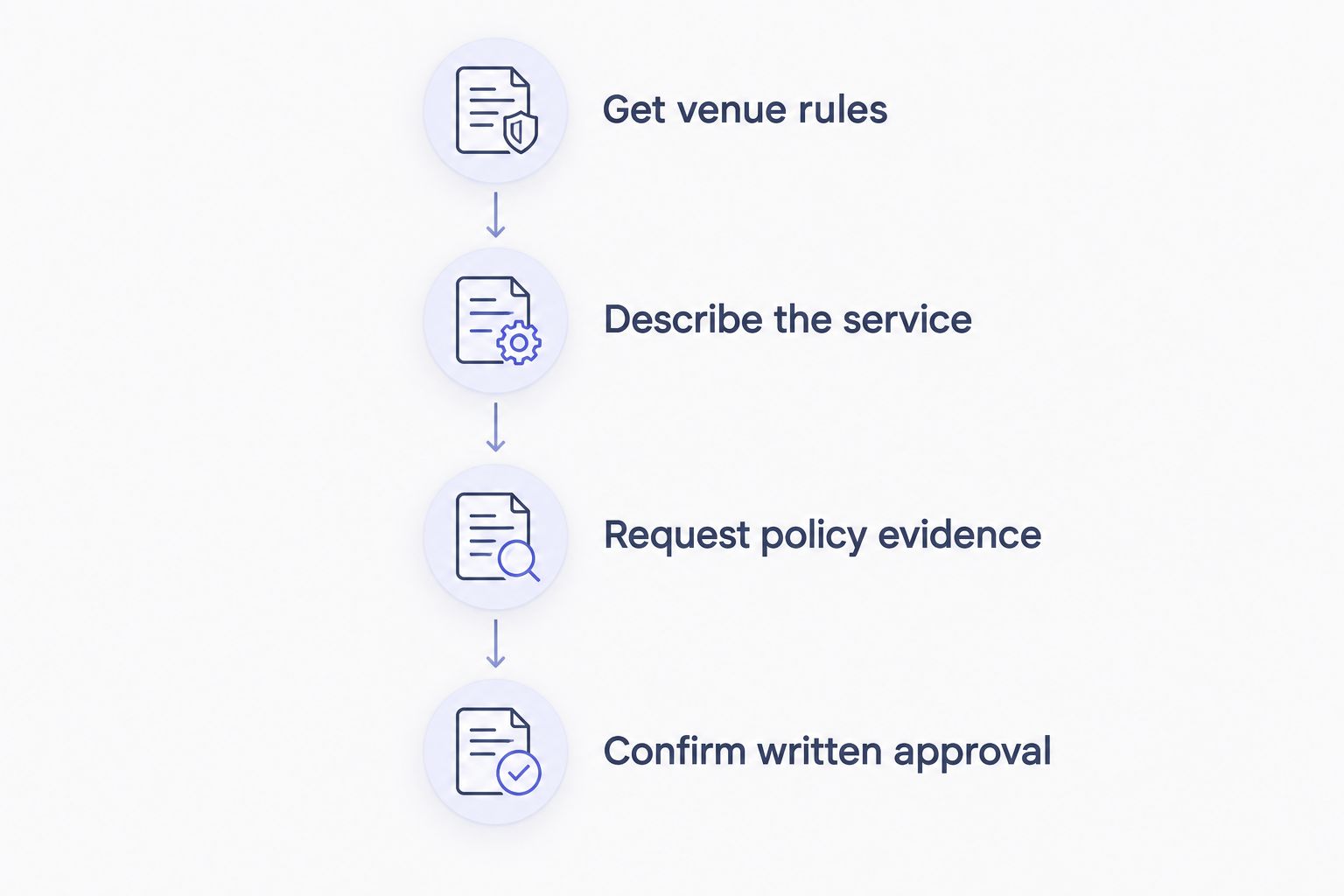
Use 4 planning steps before treating the catering arrangements as cleared for the hall. For a 2026 event, review the current agreement rather than relying on paperwork saved from another gathering.
- Get venue rules. Obtain the facility agreement, vendor requirements, document deadline, and reviewer’s contact information. Keep the original instructions together.
- Describe the service. Tell the church and caterer whether food will be delivered, served by staff, or prepared using the church kitchen. Include setup and cleanup responsibilities.
- Request policy evidence. Send the requirements to the caterer and ask its agent to provide the requested certificate and endorsements. Let the insurance professionals resolve coverage questions.
- Confirm written approval. Ask the authorized church representative to confirm acceptance. Keep that approval with the catering agreement and event schedule.
These steps separate collecting documents from approving them. Receiving an attachment is not the same as determining that it satisfies the church’s requirements.
Keep 1 written approval in the event file from the church’s authorized reviewer. That gives your planning team a clear record without asking every committee member to interpret insurance forms.
Why church hall insurance requirements vary
The work taking place matters as much as the room reservation. Describe the actual plan so the church and insurance agents can assess it accurately.
- Who is hosting. Identify whether the church, a member, a family, or an outside organization is responsible for the event. Do not assume the same agreement applies to each arrangement.
- Who handles the food. Explain where the caterer’s work ends and volunteer service begins. Delivery, staffed service, and volunteer handling create different responsibilities to discuss.
- How the kitchen is used. Tell the coordinator whether the caterer needs access to appliances, preparation areas, refrigeration, or washing facilities. Obtain permission rather than assuming kitchen access comes with the hall.
- What equipment is involved. Disclose proposed cooking equipment, warming equipment, and open flames. Church permission and insurance review are separate from choosing a menu.
- Whether alcohol is involved. Ask about both the church’s alcohol rules and the applicable insurance questions. A liability certificate alone is not an answer to either issue.
- What the agreement requires. Coverage limits, endorsements, contractual responsibilities, and document deadlines come from the applicable instructions. Do not substitute another venue’s checklist.
A bigger guest list is not permission to invent a coverage amount. Ask the church to state its requirement and the insurance agent to explain how the proposed policy responds.
Does drop-off catering still need insurance?
Drop-off catering still needs insurance documentation when the church requires it. Leaving after delivery does not automatically remove vendor requirements. Ask whether the church applies different instructions to delivery-only vendors and caterers who stay to serve.
The practical advantage of drop-off service is a clearer endpoint for the caterer’s on-site work, if the agreement defines it. The trade-off is that the organizer must arrange whatever food handling, serving, and cleanup the catering agreement does not include.
For staffed service, identify the duties the catering team actually accepts. Do not assume that staying through dinner means the team also handles the church kitchen, trash removal, or every spill in the hall.
Does the church’s insurance cover the caterer?
The church’s insurance does not automatically cover an outside caterer. Ask the church’s insurance agent to explain the church’s protection and the caterer’s agent to explain the caterer’s protection. Neither policy should be treated as a substitute for the other without review.
The church’s policy can be relevant to the church’s own responsibilities, but that does not establish coverage for every vendor’s work. Likewise, a caterer’s liability policy is not blanket protection for the organizer, volunteers, or every activity in the building.
For a 2026 fellowship meal, make the handoff clear: who receives the food, who serves it, and who handles cleanup. Written duties help the agents understand the arrangement; they do not rewrite the policies.
Can church volunteers serve food from an insured caterer?
Church volunteers can serve catered food when the church permits the arrangement, but the caterer’s insurance does not automatically insure the volunteers. Have the church’s agent review volunteer responsibilities and any relevant coverage questions.
Keep the food-service plan practical. Name the person receiving the order, the person supervising service, and the person responsible for leftovers and cleanup. Follow the caterer’s handling instructions and applicable food-safety requirements.
Insurance and food safety solve different problems. A certificate cannot make unsafe handling acceptable, and careful handling does not replace required insurance paperwork.
Planning a BBQ or soul food church gathering
DG&G Gravy Train Catering is a fit for church groups seeking BBQ and soul food catering in the Charlotte metro area. The Salisbury, NC company serves church gatherings as well as weddings, corporate events, and private parties.
When discussing BBQ and soul food catering with DG&G Gravy Train Catering, send the church’s vendor requirements along with your event details. Ask about the proposed service and required documentation before treating the booking as venue-approved. Choosing a menu does not establish insurance coverage or church acceptance.
Keep the conversation warm and practical: y’all can plan the fellowship meal while the authorized reviewers settle the paperwork. Bring the event date, hall location, expected attendance, service arrangements, and written venue requirements to the discussion.
Plan Your Church Gathering
Share your gathering details and the church’s vendor requirements before finalizing catering arrangements.
FAQ
Is catering insurance required for a church fellowship hall in 2026?
Catering insurance is required when the church’s facility-use agreement or vendor rules require it. Applicable legal obligations also depend on the business and jurisdiction, so confirm both the venue requirements and relevant legal duties.
What should I ask the church before booking a caterer?
Ask for the current facility-use agreement, outside-vendor insurance requirements, submission deadline, and authorized reviewer. Confirm whether the organizer needs separate event insurance.
Is a certificate of insurance enough for the church?
A certificate is enough only if it satisfies the church’s documentation requirements; it does not change coverage. If the church requires additional insured status, ask its reviewer what endorsement evidence is needed.
What is the difference between a certificate holder and an additional insured?
A certificate holder receives evidence of insurance, while an additional insured has insured status under the applicable policy wording. Naming the church as a certificate holder does not by itself grant additional insured coverage.
Do we need event insurance if the caterer is insured?
The caterer’s insurance does not automatically replace the organizer’s event insurance. Ask the church whether it requires separate host coverage and have an insurance agent review the organizer’s responsibilities.
Do volunteers need to buy their own insurance to serve dinner?
Do not assume volunteers must buy individual policies or that the caterer’s insurance covers them. Ask the church’s insurance agent how its policies address volunteers and the planned food-service duties.
Can I ask DG&G Gravy Train Catering about a church fellowship meal?
DG&G Gravy Train Catering serves church gatherings with BBQ and soul food across the Charlotte metro area. Share your event details and the church’s written vendor requirements when discussing arrangements.
One last thing
A church’s name appearing on a certificate does not tell you what coverage the church receives. The distinction between certificate holder and additional insured is small on paper but important when reviewing the actual arrangement.
Before your 2026 gathering, ask the church’s authorized reviewer to confirm acceptance of the required documents. Then keep the approval, catering agreement, and service responsibilities together, so the folks welcoming guests are not also hunting for insurance emails.