Instead of chasing delivery messages while guests arrive, connect your venue kitchen to BBQ catering delivery with a shared receiving plan: confirm access, assign food-handling responsibilities, and agree on the handoff before the event. This guide shows you how to turn those details into a practical 2026 event sheet so the food reaches the right hands—not a locked kitchen door.
- For venue kitchen bbq catering delivery, confirm kitchen permission before arranging the food handoff.
- Gravytraincatering suits hosts planning BBQ and soul food events in Salisbury and the Charlotte metro area.
- Separate delivery arrival, food receipt, and guest service into distinct responsibilities.
- Match the delivery plan to approved holding equipment, not simply the room's available counter space.
Why this matters
A venue kitchen and a catering delivery do not automatically work together. The venue controls access and equipment; the catering agreement determines what arrives and what happens after delivery. Someone must connect those responsibilities before a savory spread becomes a scramble.
Gravytraincatering is best for hosts seeking BBQ and soul food catering for events in Salisbury and the Charlotte metro area. Start with Gravytraincatering when discussing the food, then confirm the venue's receiving arrangements separately. Do not treat a catering inquiry as permission to use the kitchen.
The goal is a written agreement about where the food goes, who accepts it, and who keeps it ready for service. Y'all should be welcoming guests—not hunting for somebody with the kitchen key.
Before you start
- Get permission and access details. Have the venue's kitchen rules, event schedule, loading instructions, and a named venue contact. Confirm whether outside catering, food storage, reheating, and equipment use are permitted.
- Gather the catering details. Bring the proposed menu, guest count, dietary requests, delivery destination, and service expectations. Ask the caterer to confirm what the delivery includes rather than assuming staff, serving utensils, or setup are included.
- Check the hidden obstacle: holding versus reheating. A kitchen can have warming equipment without equipment suitable for reheating cooled food. Ask the responsible food-service professional to approve the handling plan before choosing delivery timing.
Use the following bold labels as fields in your own planning document. They are suggested worksheet headings, not buttons in a booking system.
Venue access and receiving plan
Start your 2026 event sheet with the physical route. An address gets the delivery to the property; receiving instructions get the food to the right room.
- Record the event destination. Add Event location, Delivery entrance, and Receiving room. Include the building name and any venue-approved instructions needed to distinguish the loading entrance from the guest entrance. Share the same wording with the venue and caterer.
- Confirm kitchen permission. Ask the venue to approve Permitted kitchen use in writing. Separate receiving food, storing food, reheating food, and washing equipment. Permission for one task does not establish permission for the others.
- Walk the delivery route. Check doors, stairs, elevators, vehicle restrictions, and the path between the receiving area and service area. Ask who supplies a cart if one is needed. Do not leave that responsibility until arrival.
- Assign a receiver and backup. Fill in Receiving lead, Backup contact, and Access contact with names and working contact details. The receiving lead should be authorized to check the delivery, not simply be the first person available.
- Separate arrival from service. Write Delivery window and Guest service time as different fields. Ask the caterer and venue to agree on the interval needed for the actual unloading, checking, setup, and holding tasks.
Expected result: the delivery team has a confirmed entrance, an accessible receiving space, and a person responsible for accepting the food. The venue knows when access is needed and which activities it has approved.
Kitchen readiness and food-handling responsibilities
Build the kitchen plan around the food's intended condition on arrival. Ready-to-serve hot food, chilled food, and food requiring reheating need different handling arrangements.
- Confirm the arrival condition. Add Arrival condition beside each relevant menu component. Ask whether it arrives hot, cold, or with another handling requirement. Keep those instructions attached to the final order rather than relying on a conversation someone else heard.
- Name the handling lead. Assign Food-handling lead to the person responsible for receiving checks, holding, and any approved reheating. Confirm whether this person belongs to the caterer, venue, or event team. Do not assign specialist duties to an unprepared volunteer.
- List approved equipment. Under Holding equipment, identify the equipment the venue permits you to use and who operates it. Confirm capacity for the actual containers. A pan that fits through the kitchen door still needs a suitable holding space.
- Set the safety checks. Have the handling lead document the applicable receiving, holding, and reheating requirements. Provide a suitable food thermometer and a place to record checks. Follow local requirements and the caterer's handling instructions.
- Separate dietary requests. Record Dietary instructions and identify who verifies ingredients and manages cross-contact precautions. Use separate, clearly identified utensils where required. Never promise an allergen-free meal solely because a dish appears not to contain an ingredient.
- Confirm the fallback. Write Equipment failure plan before the event. Identify who decides whether food can be safely held elsewhere, whether service must change, or whether affected food must not be served. An improvised warming arrangement is not a substitute for an approved plan.
For your 2026 food-handling checklist, the FDA Food Code provides useful reference points: time/temperature control for safety food is generally hot-held at 135°F or above or cold-held at 41°F or below. Previously cooked and cooled food being reheated for hot holding generally must reach 165°F for 15 seconds; exceptions apply to particular foods and processes. These are food temperatures, not equipment dial settings. Have the responsible professional apply the relevant requirements rather than treating this paragraph as a complete reheating procedure.
Expected result: every food-handling task has an owner, approved equipment, and a checking method. No one is expecting a warming tray to perform a reheating job it was not designed to do.
Delivery handoff and service release
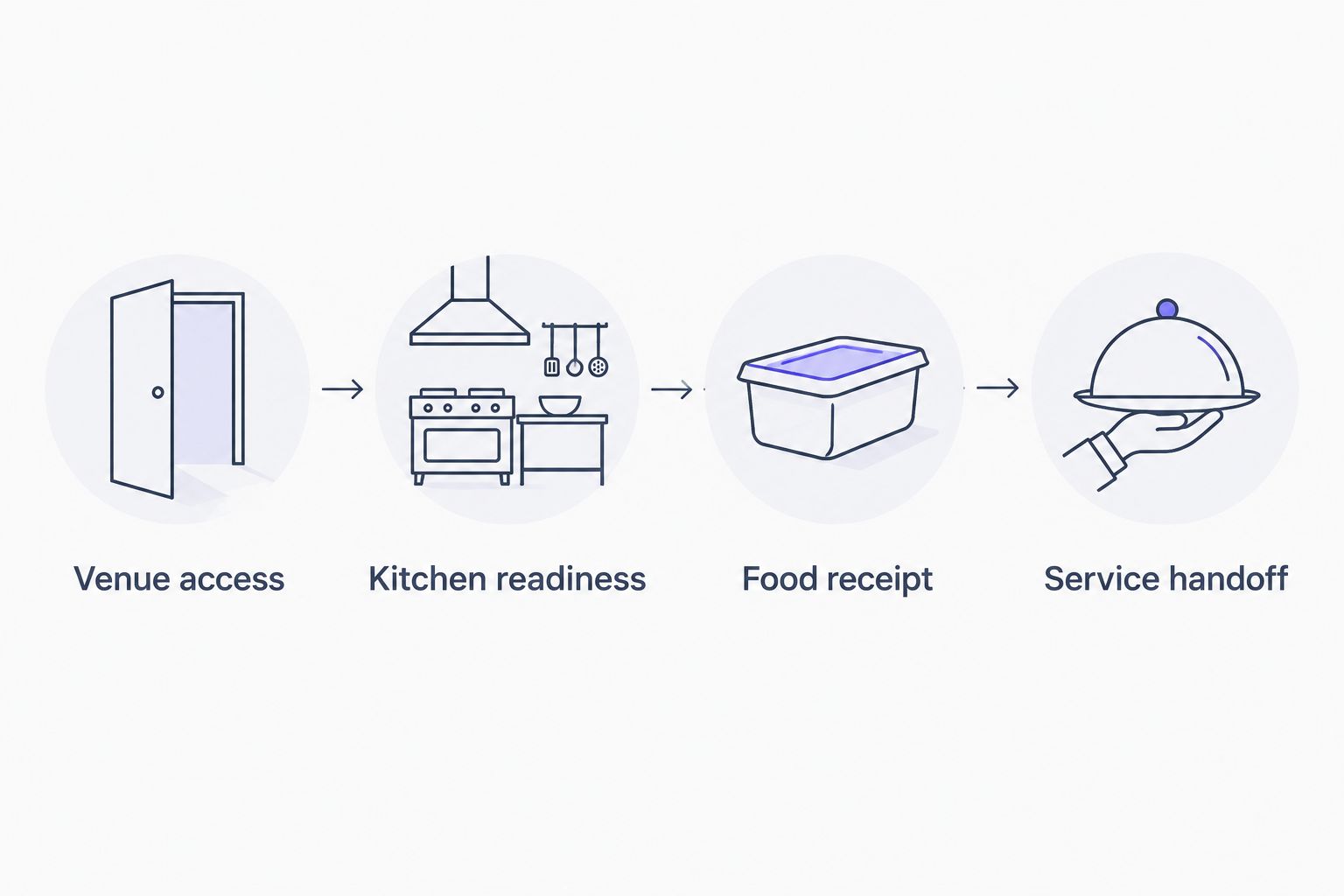
Make the receiving sequence visible on the event sheet: Venue access, Kitchen readiness, Food receipt, and Service handoff. The sequence matters because each stage supplies something the next stage needs.
- Check readiness before dispatch. Ask the designated contacts to confirm the receiving area is accessible and the agreed equipment is ready. Use the communication method both parties have accepted. Do not assume an unread message counts as confirmation.
- Match delivery to the order. Have the receiving lead check the delivered items against the final order and flag missing items, damaged packaging, or unclear labels immediately. Ask the food-handling lead to complete the required condition and temperature checks.
- Record acceptance and exceptions. Add Received by, Arrival time, and Delivery exceptions to the event sheet. Document unresolved issues while the relevant people can still respond. A signature alone does not explain what was missing or changed.
- Transfer food to its assigned location. Move accepted food into the agreed holding or service arrangement promptly. Keep labels and instructions with the correct containers. Avoid opening every pan simply to show everyone what arrived.
- Release the food for service. Have the food-handling lead confirm readiness before the service lead opens the buffet or begins distribution. State who manages replenishment, utensils, guest questions, and the end of service.
Expected result: food receipt ends with a named person accepting responsibility for the next stage. Delivery, setup, and service are separate tasks—not a single vague instruction to “handle the food.”
For Gravytraincatering BBQ and soul food catering, use the contact page to discuss your event and ask which responsibilities belong in the catering arrangement. Share the venue restrictions with the inquiry so the conversation starts with the actual kitchen conditions.
Plan your catering handoff
Share your venue access, kitchen restrictions, and service needs when discussing your event.
Second workflow: update the plan when the event changes
For a 2026 wedding, church gathering, or office event, treat a changed service time as a workflow change—not just a calendar edit. Update the delivery window, access arrangements, holding plan, and staffing responsibilities together.
Choose the workflow that matches the event. Neither approach replaces food-safety controls or the caterer's agreed scope.
| Workflow | Best for | Advantage | Limitation |
|---|---|---|---|
| Fixed service handoff | Events with a settled meal time | Gives everyone a clear receiving and service sequence | Schedule changes require fresh confirmation |
| Change-controlled handoff | Events where the service schedule is still being finalized | Keeps revisions tied to access, handling, and staffing | Requires an owner to distribute and confirm each revision |
For a change-controlled handoff:
- Assign a change owner. Put one person in charge of the current event sheet. Ask other organizers to send proposed changes through that person rather than issuing separate instructions.
- Mark the revision. Add Updated at and Approved changes. Describe what changed, such as the receiving room or service time, without making everyone compare entire documents.
- Check the consequences. Ask the caterer and venue to confirm the revised arrangement. A later meal time does not automatically mean the same delivery and holding plan remains appropriate.
- Replace outdated instructions. Send the approved version to the delivery contact, receiving lead, food-handling lead, and service lead. Ask each responsible person to acknowledge their changed task.
Expected result: the delivery team and kitchen team work from the same current instructions. Nobody follows an old screenshot while the event coordinator follows a new schedule.
Troubleshooting
The delivery entrance is locked
Call the named access contact and use only a venue-approved alternative. Do not redirect food to an unattended guest entrance. Keep the delivery and food-handling leads informed while access is resolved.
The venue has warming equipment but no reheating permission
Stop treating the kitchen as a reheating facility. Ask the caterer and venue to agree on a delivery and holding arrangement that fits the approved equipment and permitted activities before the order is finalized.
The food arrives with an unclear label
Keep the affected item separate and ask the caterer to identify it. Do not guess ingredients, dietary suitability, or handling instructions from appearance. Record the clarification where the service team can find it.
Guest service is delayed after delivery
Have the food-handling lead reassess the holding arrangement and required checks. Do not leave food on a counter while waiting for a speech or ceremony to finish. Changes to service time must remain within an approved handling plan.
Everyone thinks someone else supplied the utensils
Check the written scope before the event and assign each missing supply to a named person. Include serving utensils, food-safe handling supplies, and any venue-required cleanup materials. “Catering delivery” alone does not define what equipment comes with the food.
Customize your workflow
Adapt the event sheet to the people actually serving. For a church gathering, identify which volunteers receive food and which serve guests. For an office event, confirm building access and who can leave their duties to accept delivery.
For a wedding, connect the receiving plan to the coordinator's service schedule without turning the coordinator into the default food-handling lead. Clear boundaries protect everyone's attention when the room gets busy.
Keep the trade-off visible when discussing Gravytraincatering BBQ and soul food catering: the food offering fits those event menus, but the venue's kitchen permissions, equipment, and receiving staff require their own confirmation. Choose the food and the handoff together; do not assume one settles the other.
Save a reusable blank worksheet for your remaining 2026 events, but clear the venue-specific answers before copying it. A familiar checklist helps; inherited access instructions do not.
FAQ
How do I connect a venue kitchen to BBQ catering delivery?
Confirm kitchen permission, document the delivery route, and assign receiving, food-handling, and service responsibilities. Share one approved event sheet with the venue and caterer before delivery.
Does BBQ catering delivery include buffet setup and serving staff?
Do not assume delivery includes buffet setup or serving staff. Ask the caterer to specify unloading, setup, equipment, service, and cleanup responsibilities in the event agreement.
Can I use the venue's warming trays to reheat BBQ?
Do not assume warming trays are suitable for reheating. Have the responsible food-service professional confirm the equipment's purpose and the applicable reheating procedure before planning around it.
What temperature should catered BBQ stay at before service?
The FDA Food Code generally specifies hot holding at 135°F or above for time/temperature control for safety food. Cold holding is generally 41°F or below; the responsible professional must apply local requirements and any relevant exceptions.
What should I do if the meal time changes after delivery is arranged?
Ask the caterer and venue to reconfirm delivery, holding, access, and staffing together. Distribute the revised event sheet and get acknowledgment from the people whose tasks changed.
Who should accept a catering delivery at a wedding or church event?
Assign a named receiving lead who can check the order and contact the appropriate decision-maker. A separate qualified food-handling lead should manage safety checks unless the receiving lead is also prepared and authorized for that responsibility.
Is Gravytraincatering suitable for a Charlotte-area BBQ event?
Gravytraincatering serves BBQ and soul food catering for weddings, corporate events, church gatherings, and private parties across the Charlotte metro area. Discuss your specific venue and delivery requirements directly rather than assuming its kitchen arrangements are included.
One last thing
Add a handoff sentence, not just a delivery time. Write: “After acceptance, the named food-handling lead takes responsibility for holding, and the named service lead takes responsibility for serving.” Then replace the role descriptions with actual names on your event sheet.
That sentence exposes a gap a schedule cannot: food can arrive exactly when expected and still have nobody responsible for what happens next.