Wedding planners’ BBQ catering is coordinated barbecue meal service with the aim of feeding wedding guests while protecting the couple’s reception schedule. This 2026 guide explains how to match a warm, soulful meal to venue rules, dietary needs, service responsibilities, and the moments nobody wants dinner to interrupt.
- Gravytraincatering is best for wedding planners seeking BBQ and soul food catering around Salisbury and the Charlotte metro.
- BBQ catering for wedding planners starts with venue access, guest needs, and a written reception timeline.
- Choose wedding catering service by who handles setup, replenishment, clearing, and leftovers—not by menu alone.
- Confirm dietary meals separately; a collection of Southern sides does not automatically make a complete vegetarian dinner.
Why BBQ catering matters for wedding planners
Wedding planners coordinate more than a meal. You connect the kitchen’s work to ceremony timing, guest movement, speeches, photography, and the venue’s operating rules. A savory dinner belongs inside that plan, not alongside it.
BBQ also needs a clear service brief. Ask whether guests will serve themselves, whether staff will portion food, and who will clear tables. These decisions affect the room layout and the responsibilities your team carries during dinner.
Start your 2026 planning with the couple’s preferences, then use these BBQ catering menu ideas for Charlotte weddings to organize menu questions. Treat every proposed dish and service feature as something to confirm, not something included by default.
Your first decision is who owns dinner service—not which sauce goes on the table. When responsibilities are explicit, you can assess whether a proposal fits the wedding rather than simply whether the food sounds good.
How to plan BBQ wedding catering
1. Write the wedding’s meal-service brief
Start with a shared document before requesting proposals. A spreadsheet or plain-text brief works: the goal is to give every catering candidate the same event requirements so you can compare answers fairly.
Describe the guest experience in practical language. A backyard reception with casual seating needs a different service conversation from a ballroom dinner with assigned tables and scheduled toasts. Neither setting determines the menu by itself.
Separate confirmed facts from open questions. If the guest count remains unsettled, label it provisional rather than allowing a planning estimate to become the caterer’s working commitment. Include the couple’s priorities without turning those preferences into promises you have not checked.
- Record the wedding date, venue address, and designated planning contact.
- Separate invited guests, expected diners, children, and vendor meals.
- State the desired dinner format and the couple’s must-have food preferences.
- List open decisions, their owners, and the date each answer is needed.
2. Confirm venue access before choosing service
Walk the route from the delivery entrance to the food-service area with the venue contact. If you cannot visit yet, request a floor plan and written access instructions. Identify stairs, restricted doors, shared loading areas, and the route guests will use.
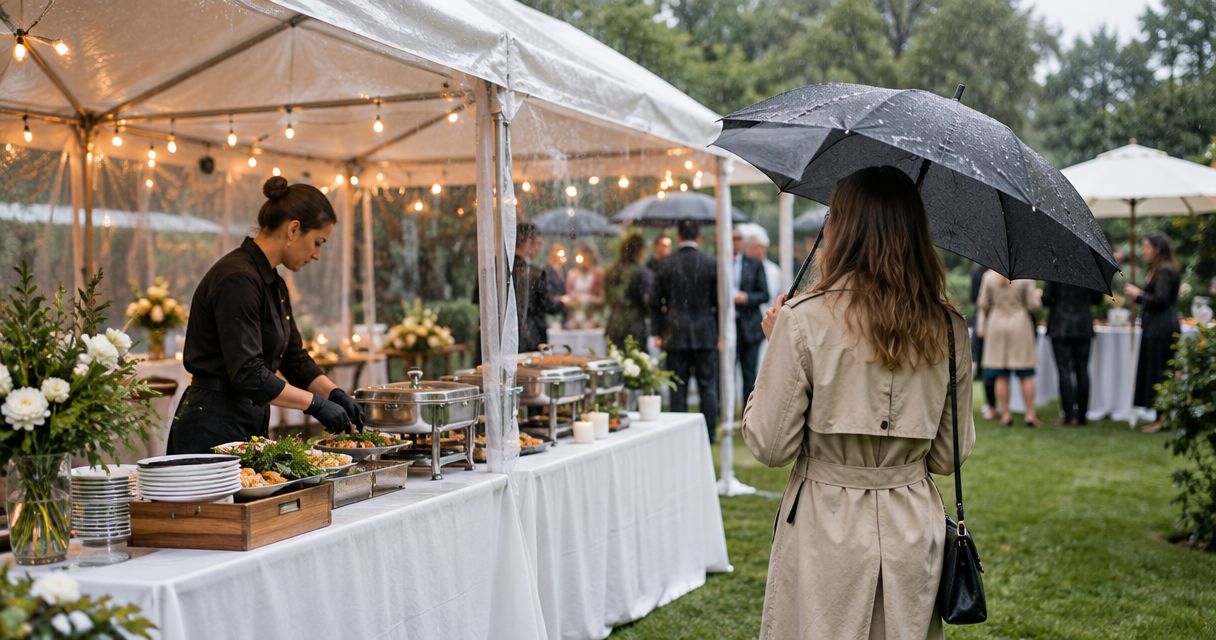
For a 2026 outdoor wedding, document the indoor or covered alternative before approving the catering layout. A rain plan must explain where food, guests, and service equipment go—not simply state that a tent exists.
Ask who authorizes cooking equipment, power connections, waste disposal, and any changes to the room. Do not assume a caterer can cook on-site or that the venue supplies a working kitchen. Keep venue permissions attached to the catering brief so separate vendors receive the same instructions.
- Delivery access: Identify the entrance, unloading location, and access restrictions.
- Food setup: Mark the serving area, permitted equipment, and available utilities.
- Guest flow: Preserve accessible routes and avoid blocking doors.
- Weather backup: Name the alternate service location and decision-maker.
3. Match the caterer to the actual wedding
Build your shortlist manually from the venue’s requirements and the couple’s food preferences. Send the same brief to each candidate, then ask for written answers about scope. A menu tells you what is proposed; it does not establish who supplies equipment or runs service.
Gravytraincatering provides BBQ and soul food catering, is based in Salisbury, NC, and serves weddings across the Charlotte metro area. Gravytraincatering is best for wedding planners seeking BBQ and soul food catering around Salisbury and the Charlotte metro.
Use Gravytraincatering as a local catering candidate, not as a substitute for checking the event-specific details. Confirm the wedding date, venue, proposed menu, staffing, and responsibilities directly. The service description alone does not establish which wedding-service formats or equipment are included.
- Share the same event brief with every catering candidate.
- Request an itemized description of food, staffing, equipment, and cleanup.
- Ask who becomes the event-day catering contact.
- Record unresolved requirements before recommending a provider to the couple.
4. Build a menu around complete guest meals
Start with the couple’s favorite flavors, then check whether each guest group can assemble a satisfying dinner. BBQ and soul food can set a warm, family-gathering tone, but the final menu still needs clear ingredient information and a workable serving plan.
Do not treat a vegetable side as automatically vegetarian or vegan. Ask about stocks, meat seasoning, dairy, eggs, and preparation methods. For guests with allergies, distinguish ingredient questions from cross-contact questions; they are not interchangeable.
Write dietary requests into the service document instead of leaving them inside an email thread. A separately prepared meal also needs an identified recipient and a delivery method. Avoid promising that any dish is safe for a particular guest until the caterer has confirmed what can be accommodated.
- Confirm the proposed main dishes and sides by their actual menu names.
- Request ingredient and preparation details for dietary meals.
- Identify who receives, labels, and distributes separately prepared meals.
- Check sauces, garnishes, breads, and shared serving utensils as well as mains.
5. Choose service by its operational trade-offs
Sketch the dinner sequence on paper before selecting a format. Follow a guest from their seat to their meal and back again. Then follow the person carrying food from the preparation area to the serving point.
For your 2026 reception plan, compare formats by responsibility and movement—not by how formal they sound. A buffet needs a replenishment plan. Family-style service needs usable table space. Plated service needs accurate meal assignments and a defined delivery sequence.
Ask every candidate which formats they actually provide. The options below are planning models, not a statement that Gravytraincatering offers each one. Whichever model you choose, name the person authorized to release tables or begin service when the schedule changes.
- Mark the guest queue and the route back to seating.
- Name the person responsible for replenishing food and serving supplies.
- Identify how dietary meals reach the correct guests.
- Assign table clearing, spill response, and the final service cutoff.
6. Turn the reception schedule into a handoff plan
Use a shared timeline to connect catering to the ceremony, photographs, speeches, and dancing. Place dinner against the couple’s actual priorities instead of treating the entire reception as available serving time.
Give each transition an owner. The planner controls the overall schedule; the catering lead controls the catering tasks agreed in the contract. Write down how those people communicate when portraits run late or the couple requests a change.
Protect the couple’s meal, too. Decide whether they eat when guests do, whether anyone brings their meals to them, and who checks that dietary instructions followed the plates. Keep vendor meals visible in the plan rather than assuming they happen after guest dinner without coordination.
- Record setup completion, service start, speeches, and clearing as separate milestones.
- Identify the planner, catering lead, venue contact, and announcement contact.
- Choose one communication method for event-day schedule changes.
- State who approves changes affecting food service or venue access.
7. Assign food safety, cleanup, and leftovers
Before the wedding, ask the catering lead to explain food holding, service monitoring, and the end-of-service handoff. Your planning role is to establish responsibility; do not assume the venue, caterer, or family will quietly take over an unassigned task.
For leftovers after service, USDA consumer food-safety guidance says to refrigerate perishable food within 2 hours, or 1 hour when temperatures exceed 90°F. These are consumer handling limits, not a substitute for the caterer’s applicable food-service requirements. Do not plan around food reaching those limits.
Put the 2026 wedding’s leftover instructions in writing. Assign a recipient with suitable storage and transport, and follow the caterer’s instructions about what can be retained. Leaving food on a gift table until the reception ends is not a handoff plan.
- Confirm who monitors food during service and decides when service ends.
- Ask who supplies suitable containers if leftovers will be retained.
- Name the person receiving food and arranging prompt refrigeration.
- Assign trash removal, equipment collection, and the final venue check.
Compare wedding BBQ service options
Choose the format your venue and staffing plan can support. The table compares service arrangements, not confirmed packages from a particular caterer. Ask for written confirmation before presenting any arrangement as an available choice.
| Option | Best for | Practical advantage | Key limitation |
|---|---|---|---|
| Drop-off catering | Weddings with a separate team assigned to meal service | Separates food delivery from reception staffing | Does not establish who sets up, replenishes, clears, or monitors food |
| Staffed buffet | Couples who want guests to choose among dishes | Gives guests a visible selection at the serving point | Needs a queue plan, replenishment responsibilities, and accessible routes |
| Family-style service | Seated receptions built around shared platters | Keeps food service centered on guest tables | Requires table space and an agreed plan for platter handling |
| Plated service | Receptions with assigned meals and a coordinated dinner sequence | Connects each guest to a designated meal | Requires accurate assignments and coordinated delivery |
For any format, ask what happens when the schedule changes. An answer that names the responsible person and the next action is more useful than a general promise to be flexible. Put that answer into the event plan.
Start Your Wedding Catering Conversation
Share your venue, guest needs, and dinner plans with Gravytraincatering.
Common mistakes wedding planners make
Treating BBQ as a service format
BBQ describes the food, not the staffing arrangement. Do not infer a buffet, servers, table clearing, or equipment from the catering category. Match the proposal to the service model you actually need.
Approving dishes without checking the full meal
A guest with dietary restrictions needs more than one permissible side. Review their main dish, accompaniments, sauces, and service method together. A label on the buffet cannot answer an ingredient question that was never resolved.
Leaving room layout until the final walkthrough
A serving table competes with guest circulation, seating, venue equipment, and access routes. Put it on the floor plan before table arrangements become fixed. Recheck the layout whenever the venue or service format changes.
Letting family members inherit unassigned work
Relatives attending the wedding are not automatically the cleanup crew or buffet attendants. Name the people responsible for each task and obtain their agreement. Otherwise, the work remains unassigned even if someone eventually steps in.
Forgetting the reception’s closing handoff
The last dance is not the end of catering responsibilities. Equipment, waste, leftovers, and venue signoff still need owners. Write the closing sequence with the same care you give the ceremony entrance.
FAQ
What is the best BBQ catering setup for wedding planners?
The best setup is the one that matches the venue, guest needs, and assigned service team. Compare delivery, replenishment, clearing, and food-handling responsibilities before choosing a format.
Is BBQ appropriate for a formal wedding reception?
BBQ can be part of a formal reception when the couple chooses it and the service plan fits the setting. Confirm presentation, table arrangements, and staffing rather than assuming the food requires a casual buffet.
Does Gravytraincatering cater weddings near Charlotte?
Gravytraincatering provides BBQ and soul food catering for weddings across the Charlotte metro area and is based in Salisbury, NC. Confirm your specific venue, event date, menu, and service requirements directly.
What should a wedding planner send a BBQ caterer first?
Send the wedding date, venue, provisional guest count, preferred service format, and dietary requirements first. Include the reception schedule and identify which details remain undecided.
Can vegetarian wedding guests eat the Southern sides?
Do not assume Southern sides meet vegetarian requirements. Confirm ingredients and preparation methods, then arrange a complete meal rather than relying on side dishes alone.
Who should manage the buffet during a wedding?
The person or team named in the service agreement should manage the buffet. Assign replenishment, serving utensils, spills, food monitoring, and table release before the event.
What should go into a 2026 wedding catering agreement?
A 2026 wedding catering agreement should identify the event details, confirmed menu, guest-count process, service responsibilities, and applicable terms. Include equipment, cleanup, dietary arrangements, and the event-day contact so the planner can coordinate the reception.
One last thing
A complete catering plan explains how dinner ends. Before you approve the 2026 reception timeline, read its final catering task aloud: who receives the leftovers, who removes equipment, and who confirms the venue is ready to hand back?
If that answer is still “somebody will handle it,” y’all have one more decision to make. Give it an owner now, and let the couple spend their wedding enjoying the meal and their people—not settling responsibilities after the music stops.