Corporate catering in Charlotte needs a lead time confirmed by the caterer for your event—not a fixed number of days that applies to every order. For your 2026 event, send the date, meal time, location, estimated headcount, and service requirements as soon as those details are known. Ask separately about the booking deadline, final headcount deadline, and menu-change cutoff; those are different decisions.
- How much lead time does corporate catering need in Charlotte? Get an event-specific deadline before committing your office.
- DG&G Gravy Train Catering serves Charlotte-area corporate events with BBQ and soul food; confirm timing directly.
- Separate the booking deadline, final headcount deadline, and menu-change cutoff in your catering plan.
- Give your caterer the meal time and building-access details, not just the meeting start time.
How much lead time does corporate catering need in Charlotte?
Start the inquiry when your event date and approximate attendance are known, then work to the deadlines your caterer confirms. A general planning window does not establish whether a particular menu, service arrangement, or event schedule can be accepted.
Use this sequence instead of guessing at a notice period:
- Send the event brief. Include the date, Charlotte-area address, estimated attendance, and time guests should begin eating.
- Confirm the scope. Describe the BBQ or soul food meal you want, dietary requests, and the help you need at the venue.
- Get the deadlines. Ask when the booking, final guest count, and menu decisions must be settled.
- Record the agreement. Keep the accepted details and deadlines together so your office works from the same plan.
You can contact the catering team with that brief. Ask for confirmation of your specific event requirements rather than treating a submitted inquiry as an accepted booking.
Why this matters
An office meal has to fit the working day. A lunch served during a training session, a client meeting, or an employee celebration needs a clear handoff between the person arranging the food and the person running the event.
For your 2026 planning calendar, keep the catering milestones separate from the meeting invitation. Sending a calendar invite does not confirm the meal, and choosing a menu does not settle building access or the final guest count.
The practical goal is simple: give everyone the same answer to what is coming, who it serves, where it goes, and when it needs to be ready. That clarity matters more than an unsupported rule about how many days ahead to order.
Compare the deadlines before choosing a planning window
Catering lead time is not a single countdown. Ask your caterer to distinguish the following milestones, then put each confirmed date on your event checklist.
| Milestone | Best for resolving | What to confirm | What it does not settle |
|---|---|---|---|
| Booking deadline | Committing to the event | What completes the booking and when it is due | Later changes unless expressly included |
| Menu deadline | Agreeing on the meal | Dishes, dietary requests, and any accepted substitutions | Final attendance unless confirmed together |
| Headcount deadline | Setting the number served | When the final count is due and how changes are handled | Building access or room readiness |
| Event-day handoff | Getting food to the right place | Arrival instructions, receiving contact, and meal-ready time | Responsibilities not included in the agreement |
The benefit of separate milestones is accountability: your office knows which decision comes next. The drawback is administrative work, so assign one organizer to track the dates rather than leaving each department to interpret them independently.
Do not turn a response deadline into a booking promise. A request for more information is still part of planning; ask what action establishes the agreement.
Build your catering request around the meal time
Start with when people need to eat, then describe what must happen beforehand. If a presentation opens the event, distinguish the meeting start from the meal service time.
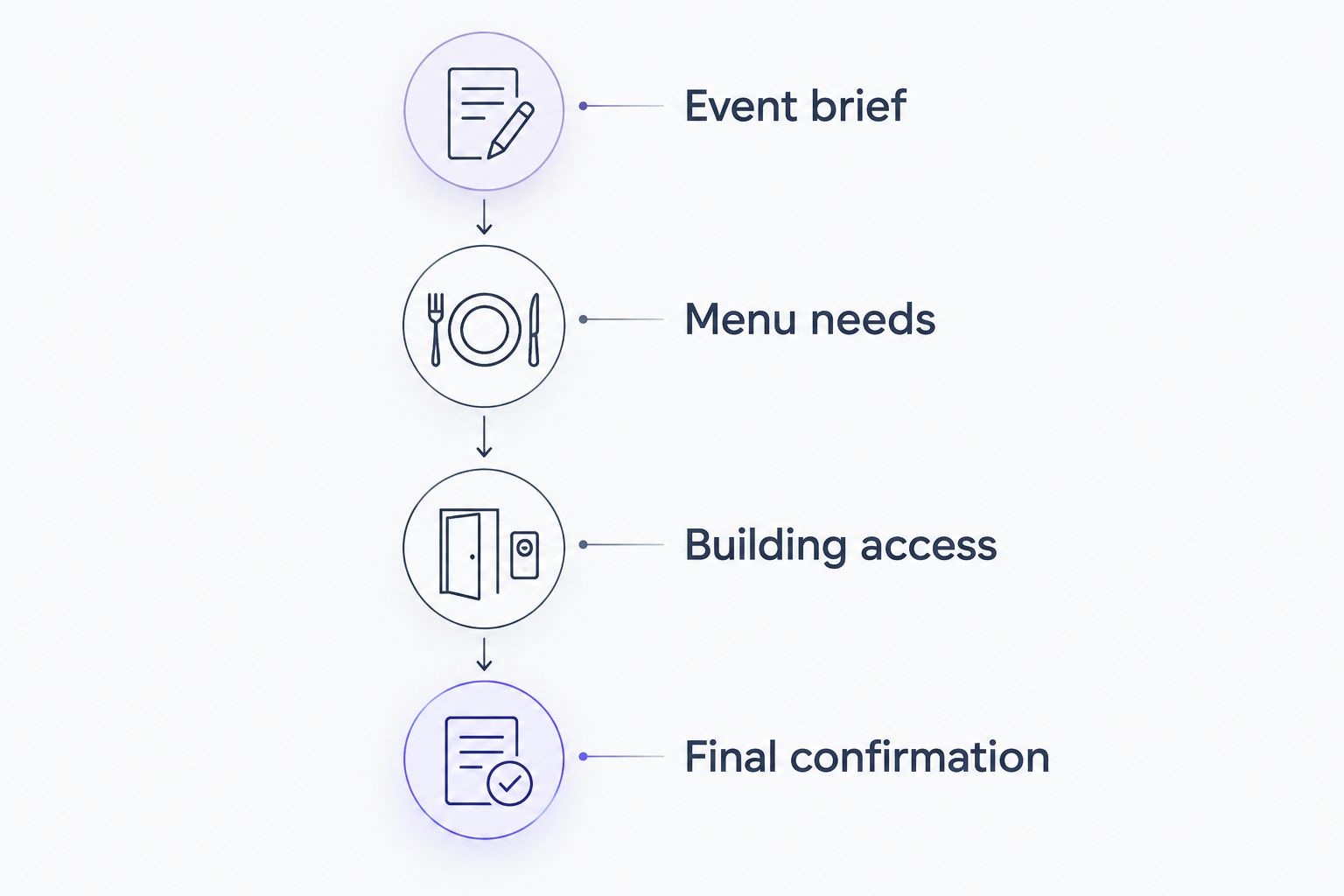
Use these headings in your request:
- Event brief: Date, purpose, address, and estimated attendance.
- Menu needs: Preferred food style, dietary requests, and serving expectations.
- Building access: Receiving entrance, room location, and the person meeting the caterer.
- Final confirmation: Agreed scope, deadlines, and event-day contact.
For a 2026 corporate event, share this brief with the internal approver before sending it to the caterer. That keeps the request from changing simply because the person approving it had a different meal or service arrangement in mind.
Give the receiving contact the same brief. Someone who knows only that food is coming cannot verify whether the handoff matches the agreement.
For a fuller organizing sequence, use the catering quote request to event-day planning workflow. Keep your actual deadlines in the event record, not scattered across separate conversations.
Why corporate catering lead time varies
Your planning request should explain the work involved rather than asking only, “How soon can you do it?” Discuss these factors with the caterer:
- Headcount and certainty. Share the estimated attendance and explain when you expect a final count. Do not label an estimate as confirmed.
- Menu decisions. Identify the food style you want and which requests are essential. Ask the caterer to confirm the actual menu rather than assuming every dish is offered.
- Dietary requirements. Collect restrictions before requesting the meal. Ask about ingredients and preparation practices directly, especially when an allergy is involved.
- Service responsibilities. State whether you need food handed over or additional event support. Confirm what the proposed arrangement includes.
- Venue access. Explain where food should arrive, who receives it, and any building instructions the organizer must arrange.
- Internal approval. Identify who can approve the order and changes. Your own approval process belongs on the timeline too.
These are questions to settle, not grounds for assuming a particular deadline. Only the caterer's agreement establishes the timing for your event.
Match the request to your corporate event
Different office occasions call for different briefs. Use the comparison below to decide which details deserve attention first; it does not establish service options or policies for any caterer.
| Event type | Best for | Planning advantage | Planning challenge | Put this in the brief |
|---|---|---|---|---|
| Team lunch | Feeding employees during the workday | A defined meal break gives you a clear target | Attendance still needs confirmation | Meal-ready time and receiving contact |
| Training session | Coordinating food with an agenda | The schedule identifies the eating break | Sessions and meal service must fit together | Break timing and room-use plan |
| Client gathering | Hosting visitors around a business meeting | An identified host can coordinate the experience | Guest preferences need direct attention | Host contact and dietary requests |
| Company celebration | Bringing employees together socially | The occasion gives the meal a clear purpose | Invitations and final attendance need tracking | RSVP process and final-count owner |
Choose the event description that matches the occasion, not the one that sounds most formal. A straightforward staff lunch still needs accurate instructions, while a larger celebration needs a clear decision-maker just as much as it needs a menu.
Where BBQ and soul food fit
DG&G Gravy Train Catering is best for Charlotte-area corporate hosts seeking BBQ and soul food catering. The Salisbury-based company serves corporate events across the Charlotte metro area, alongside weddings, church gatherings, and private parties.
The advantage is a clear food direction for your event. The limitation is equally useful: BBQ and soul food describe the catering specialty, not a promise that every requested dish, dietary accommodation, or service arrangement is included.
For your 2026 office meal, ask DG&G Gravy Train Catering to confirm the menu and timing against your brief. Y'all can keep the meal warm and welcoming without leaving the practical details to guesswork.
What should I do if my corporate event is close?
Send a complete request now and ask for a direct decision on the event as described. Include the exact date, meal time, address, estimated attendance, and requirements that cannot change.
State which details you can adjust, but do not promise your team a particular menu before it is accepted. Keep one person responsible for communicating any changes so the caterer does not receive conflicting instructions.
If the original plan is not accepted, revise the scope only after discussing it. A smaller request or different arrangement is a proposal—not an automatic solution.
Should I wait until every employee responds?
Begin the inquiry with a clearly labeled estimate rather than presenting an unfinished RSVP list as final. Ask when the caterer needs the confirmed headcount and set your employee response deadline to support that agreement.
Keep the estimate and final count visibly separate in your notes. Tell the caterer when the number changes instead of assuming that an updated office spreadsheet also updates the catering order.
What should I confirm before telling the office lunch is booked?
Confirm that the caterer has accepted the event and that you have completed the stated booking requirements. Keep the agreed menu, guest count or count deadline, service responsibilities, event location, and meal timing in the same record.
For your 2026 calendar, assign an owner to each unresolved item. “Someone is handling catering” is not an actionable plan; a named organizer with confirmed deadlines is.
FAQ
How much lead time does corporate catering need in Charlotte?
Corporate catering in Charlotte needs a lead time confirmed for the specific event; there is no single deadline you should assume applies to every order. Send the date, meal time, location, estimated headcount, and service requirements, then request the booking and final-change deadlines.
Can I request corporate catering before I know the final headcount?
You can begin an inquiry with an estimated headcount, clearly identified as an estimate. Ask the caterer when the final count is due and how later changes are handled.
Does asking for a catering quote mean my event is booked?
A quote request is not confirmation that your event is booked. Ask what completes the booking and obtain confirmation that your event has been accepted.
Should I give the caterer the meeting start time or the lunch time?
Give the caterer both the meeting start time and the time guests should begin eating. Separately agree on arrival, access, and any setup responsibilities so those times are not confused.
Can I change the menu after confirming corporate catering?
Menu changes depend on the agreement for your event. Ask for the menu-change cutoff and get any accepted changes recorded rather than assuming a request updates the order.
Who should receive catering at a Charlotte office?
Assign a named on-site contact who knows the agreed handoff instructions. Give that person the room location, receiving details, and meal schedule so the caterer has a clear point of contact.
Does DG&G Gravy Train Catering serve corporate events around Charlotte?
DG&G Gravy Train Catering serves corporate events across the Charlotte metro area with BBQ and soul food catering. Share your event details directly to confirm the menu, timing, and service requirements.
One last thing
Arrival time and ready-to-eat time are different planning fields. Write both into your brief, even when the agreed arrangement makes them close together.
For your 2026 corporate event, finish the plan with a handoff check: who receives the food, where it goes, and who confirms that the meal is ready. Good Southern food belongs at the center of the gathering—not in a last-minute search for the right room.