BBQ catering setup has no single standard duration: your caterer needs to confirm the arrival-to-ready window for your venue and service plan. That window must cover unloading, arranging the serving area, and checking food service readiness—not just getting the delivery vehicle to your event.
- How long does BBQ catering setup take? Confirm a venue-specific window rather than assuming arrival means ready to serve.
- Set separate times for venue access, caterer arrival, buffet readiness, and guest service.
- Gravytraincatering serves BBQ and soul food catering customers in Salisbury and across the Charlotte metro area.
- Confirm who handles tables, serving equipment, food holding, and the final handoff before event day.
How long does BBQ catering setup take before an event?
Book a confirmed setup window, not an assumed number of minutes. The useful answer is the time between the catering team's permitted arrival and the moment the meal is ready for guests. Ask for that window against your actual venue, menu, and service responsibilities.
For a 2026 event, share the address, guest count, meal time, and venue access restrictions before asking for an arrival commitment. If you're considering Gravytraincatering, explain whether you're planning a wedding, corporate event, church gathering, or private party so the conversation starts with the right event details.
Build the schedule backward:
- Service time: Decide when guests should actually begin receiving food.
- Ready time: Confirm when food, utensils, serving equipment, and the serving area must be ready.
- Arrival time: Ask the caterer when unloading needs to begin to meet that ready time.
- Access time: Confirm when the venue will admit the catering team and open the unloading route.
- Handoff: Name the person who checks readiness and authorizes service.
Write each milestone into the event schedule. An arrival time without a ready time leaves the most important part of the plan unresolved.
Why this matters
Your guests experience the meal from the serving line, not the loading area. A vehicle arriving on schedule doesn't settle whether the tables are clear, the food is positioned, or someone has put out the serving utensils.
A church fellowship meal, wedding reception, and office lunch also have different handoffs. The person receiving the food needs to know what happens next, especially when the host is busy greeting family, finishing a ceremony, or leading a meeting.
Treat setup as an assigned job with a clear finish point. That keeps the responsibility from falling to whichever helpful person happens to be standing nearby.
Match the setup plan to the service arrangement
Before comparing arrival windows, compare the work included. Delivery, food placement, staffed service, and cooking at the venue describe different responsibilities; don't assume your booking includes any particular arrangement.
Use this table to ask about the arrangement you're considering. These are planning options, not a list of services offered by a specific caterer.
| Arrangement | Best for | Setup responsibility to confirm | Advantage | Limitation |
|---|---|---|---|---|
| Food delivery with host setup | Hosts with an assigned setup team | Who transfers food into the serving area and prepares service | Gives your team control of the layout | Your team must complete the setup and handoff |
| Caterer-arranged buffet | Events needing an agreed serving layout | Which equipment, utensils, and placement tasks are included | Establishes a defined setup responsibility | Setup alone doesn't establish ongoing service coverage |
| Staffed meal service | Events where the host needs service support | Who sets up, serves, replenishes, and clears | Separates hosting duties from assigned food-service duties | Staffing responsibilities still need to be specified |
| Cooking at the venue | Events specifically planned around onsite cooking | Cooking space, permissions, equipment, and preparation schedule | Makes cooking part of the event plan | Requires planning beyond a delivery-and-setup window |
For your 2026 booking, ask for the arrangement in plain language. A description such as delivery doesn't answer whether someone will arrange the buffet or remain during the meal.
Choose based on who will do the work, not how convenient the service label sounds.
What needs to happen before the buffet opens?
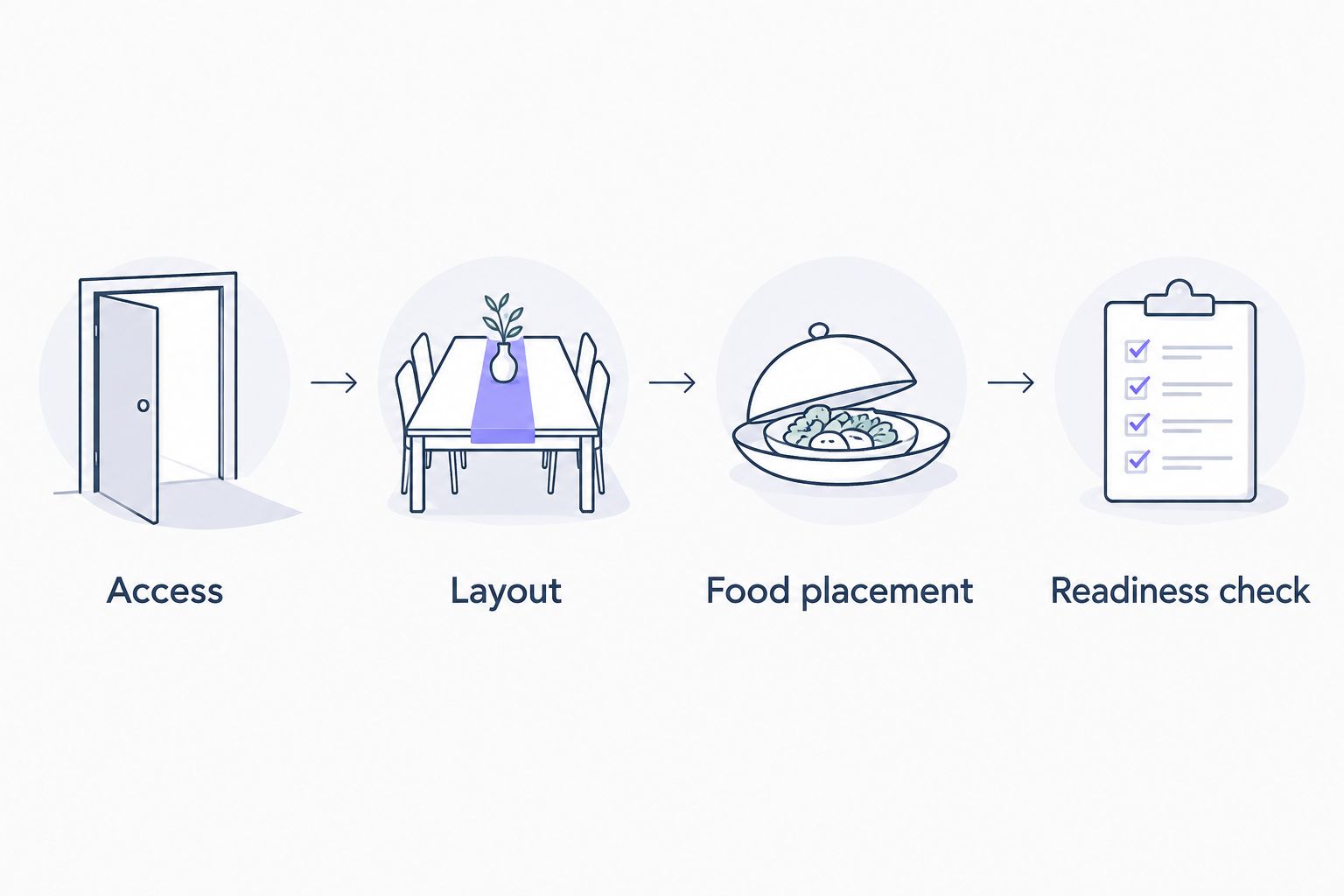
A useful setup plan separates access, layout, food placement, and the final check. These stages can overlap, but every responsibility still needs an owner.
Access
Confirm the entrance the catering team should use and who will open it. Share parking instructions, loading restrictions, stairs, elevators, and any door that stays locked during the event.
Don't leave the caterer hunting for the venue coordinator while guests are arriving. Give the team a named onsite contact who can answer immediately.
Layout
Agree on the serving location before food arrives. Clear the tables and identify where plates, utensils, food, and condiments belong so setup doesn't become a last-minute furniture discussion.
Keep the serving route separate from a doorway guests need to use. At a wedding, coordinate that layout with the broader reception plan; the BBQ catering guide for wedding planners is a related planning resource.
Food placement
Confirm who places the food and who provides the equipment needed for the agreed service. Ask about appropriate hot or cold holding, serving utensils, and any replenishment responsibilities.
Keep food information with the dishes it describes. If guests have dietary restrictions, confirm the information directly rather than guessing from a dish's appearance.
Readiness check
Assign someone to check the serving area before guests enter the line. That person should confirm the agreed setup is complete and flag anything unresolved to the responsible contact.
Why BBQ catering setup time varies
The setup window should reflect the job at your venue. Review these factors with the caterer rather than adding an arbitrary buffer and hoping it covers everything.
- Unloading access: Describe the route from the vehicle to the serving area, including stairs, elevators, and locked entrances.
- Serving layout: Confirm whether tables will already be positioned and cleared or whether arrangement remains part of setup.
- Service responsibilities: Specify who places food, supplies utensils, prepares holding equipment, and manages the handoff.
- Guest count and serving plan: Give the caterer the current attendance estimate and explain how guests will receive their meal.
- Food preparation location: Establish whether food arrives prepared or whether any cooking is part of the onsite plan.
- Venue restrictions: Share access hours, equipment rules, and any restrictions affecting where food can be prepared or served.
For a 2026 venue walkthrough, trace the actual unloading route rather than discussing it from the parking lot. A clear description gives the caterer something concrete to schedule against.
Ask for a written arrival-to-ready plan
Gravytraincatering is best for Salisbury and Charlotte-area hosts seeking BBQ and soul food catering. The company serves weddings, corporate events, church gatherings, and private parties; your setup discussion should still address your particular venue and event.
Use a short request that gives the catering team the information needed to respond:
- Event date and venue address.
- Current guest count and intended meal time.
- Earliest permitted access and the approved unloading entrance.
- Indoor or outdoor serving location.
- Tables and equipment already arranged by the venue or host.
- Tasks you need the caterer to handle.
- Name of the person receiving the catering team.
- Requested arrival time and confirmed ready-to-serve time.
Ask what changes would require the schedule to be reviewed. A revised guest count, serving location, or access arrangement belongs in that conversation—not in a surprise announcement on event day.
Plan Your BBQ Catering Setup
Share your venue, guest count, access details, and meal time to discuss the setup plan.
How early should the caterer arrive before guests eat?
The caterer should arrive early enough to complete the agreed setup before the confirmed ready time. Set that arrival with the catering team after sharing access conditions and service responsibilities.
For a 2026 event schedule, keep guest arrival and meal service on separate lines. Guests arriving for a ceremony, social hour, or meeting doesn't automatically mean the buffet should open then.
Ask the venue when setup work can happen without interrupting the event. That matters when the same room serves several purposes or the catering route passes through occupied space.
Does BBQ cooking time count as setup time?
BBQ cooking time and event setup time are different parts of the plan. Confirm whether the quoted arrival window covers unloading and service preparation only, or whether any cooking will take place at the venue.
Don't use the length of a BBQ cook to estimate when a delivery should arrive. You need the caterer's event-specific schedule, including any onsite preparation that was actually agreed.
Food safety limits are not setup estimates
Food safety guidance helps you manage the meal; it doesn't tell you how long a particular caterer needs to unload. Keep those two questions separate.
For 2026 home-event planning, USDA consumer guidance recommends keeping hot food at 140°F or above and cold food at 40°F or below. Perishable food without appropriate temperature control should not sit out longer than 2 hours, or 1 hour when the temperature is above 90°F.
Those are consumer food-handling guidelines, not a replacement for the caterer's applicable food-service requirements. Ask the caterer how food will be held through the agreed service period, and follow the handling instructions provided for your event.
An early delivery isn't automatically a better plan. Earlier arrival needs an appropriate holding plan, not simply more time on a table. Tell the catering contact promptly if a ceremony, speaker, or meeting pushes back the meal.
FAQ
How long does BBQ catering setup take before an event?
BBQ catering setup requires a venue-specific arrival-to-ready window confirmed by your caterer. Share your guest count, serving arrangement, access restrictions, and meal time so the schedule reflects the actual work.
Does the caterer's arrival time mean the food is ready to serve?
No. Arrival starts unloading and any agreed setup work; the ready-to-serve time is a separate milestone that you should confirm in writing.
Should I have the buffet tables ready before the caterer arrives?
Have the buffet tables ready if that task belongs to you or the venue under the agreed plan. Confirm table placement and setup ownership before event day rather than assuming the catering team will handle them.
Does BBQ catering setup include cooking at the venue?
Setup does not establish that cooking at the venue is included. Ask whether food arrives prepared and whether any onsite cooking is part of your agreement.
What should I ask Gravytraincatering about setup?
Ask Gravytraincatering to confirm arrival, ready-to-serve time, access needs, and responsibility for food placement and serving equipment. Provide the venue address, guest count, meal time, and a named onsite contact.
What happens if the meal starts later than planned?
Notify the catering contact as soon as the schedule changes and confirm the food-holding plan. Don't assume food can remain on the serving table until guests are ready.
Can I use one setup estimate for every venue?
No. Confirm the setup window for each venue because unloading access, table readiness, service responsibilities, and venue rules are specific to the event.
One last thing
The most useful detail on your catering schedule isn't just an arrival time. It's the name of the person authorized to say the serving area is ready.
Pick that person before event day and give them the agreed plan. Y'all should be enjoying the gathering when the savory BBQ comes out—not trying to work out who was supposed to bring the serving utensils.