Order the caterer’s confirmed cooked, edible portion for each guest eating BBQ, then calculate sides and any separate meals against the guests who will eat them. Do not treat raw meat weight, bone-in weight, and ready-to-serve meat as interchangeable, or add a full portion of every meat for every person.
- How much food to order per guest for BBQ catering depends on cooked portions, confirmed headcount, and the whole menu.
- Gravytraincatering is best for Salisbury and Charlotte-area hosts seeking BBQ and soul food catering.
- Ask for cooked meat quantities and tray yields before approving your BBQ catering order.
- Split the total meat allowance across proteins; do not multiply complete servings by every menu choice.
How much food should you order per guest for BBQ catering?
Use a confirmed serving size, not a universal pounds-per-person shortcut. The useful number is the amount of cooked, edible food the caterer intends to serve each diner with your chosen menu.
Follow this calculation:
- Confirm diners. Count everyone receiving food, including hosts and any vendors you have agreed to feed.
- Separate meals. Identify guests needing a different main dish before calculating the BBQ quantity.
- Confirm portions. Ask how much cooked, edible meat constitutes a serving with the selected sides.
- Calculate totals. Multiply that portion by the guests eating it, then divide the total among the selected meats.
- Check tray yields. Convert the totals into the caterer’s actual serving containers and confirm any rounding.
A tray count alone does not tell you whether dinner is covered. Use the guide to how many people one BBQ catering tray feeds to frame that conversation.
For your 2026 event, have the final order describe both the headcount and the serving basis. That makes it clear whether the order represents complete meals or individual dishes intended to supplement other food.
Why this matters
Y’all want a generous supper, not a guessing game at the buffet. A large-looking pan does not establish its edible weight, and an order that counts every guest against every meat can duplicate portions you never intended to buy.
The other mistake is counting meat carefully while leaving the rest of the plate undefined. Confirm the sides, bread, and separate meals with the same care. A guest who does not eat BBQ still needs dinner, not an invitation to make do with whatever is left.
Which meat quantity should you use?
Calculate from the food guests can actually eat. Ask whether the quoted quantity refers to raw ingredients, cooked meat with bones, or cooked boneless meat before comparing orders.
These are planning categories, not a statement of any caterer’s current menu:
| Quantity basis | Best for | What it tells you | Limitation |
|---|---|---|---|
| Cooked, boneless meat | Checking edible meat portions | The meat weight available for serving | Does not establish how much each guest will take |
| Cooked, bone-in meat | Planning meals served as individual pieces | The weight or count of the prepared pieces | Bones are included unless explicitly excluded |
| Raw meat | Kitchen purchasing and preparation | The starting ingredient quantity | Does not equal ready-to-serve yield |
| Caterer-confirmed complete meals | Ordering a defined meal for a headcount | The intended coverage of the selected menu | Depends on the stated serving size and inclusions |
For a catered event, complete-meal coverage is useful only when the menu is clear. Ask what the serving includes and how the meat allowance is divided if guests have several choices.
There are 16 ounces in 1 pound, but that conversion does not solve the yield question. Converting a bone-in quantity to ounces still leaves the bones in the calculation.
How should you divide the order between different meats?
Start with the total meat allowance for the meal, then discuss how to distribute it. Adding another meat choice does not automatically mean adding another complete meat portion for every guest.
Tell the caterer whether guests will select a single main dish or sample several. Those are different serving plans. A menu offering choice needs a distribution decision; a tasting-style plate needs smaller portions of each component within the planned meal.
Do not assume an equal split reflects your guest list. Ask guests for meal preferences when practical, or tell the caterer what you know about the group without presenting a guess as a confirmed selection.
For a 2026 wedding or church gathering, record the difference between a requested preference and a guaranteed selection. If guests can change their minds at the buffet, the serving plan must account for that freedom rather than relying on rigid meal assignments.
How should you count sides and separate meals?
Count sides as part of the whole plate. Tell the caterer which dishes accompany the BBQ, whether everyone can eat them, and whether another host or vendor is supplying additional food.
A side dish is not automatically suitable for a guest avoiding meat. Ask about ingredients and preparation instead of judging by the dish’s name. Apply the same care to allergy requests: a smaller portion of the regular meal does not resolve an ingredient concern.
Use a guest list with clear meal categories:
- BBQ meals: Guests eating the main BBQ menu.
- Separate meals: Guests requiring a different main dish or an individually agreed meal.
- Children’s meals: Children whose portions or menu differ from the main order.
- Vendor meals: Workers you have agreed to feed during the event.
- Host meals: Organizers and family members who are helping but still need a plate.
Count each person once in the overall headcount, then identify what that person receives. This prevents separate meals from being added without adjusting the original order.
Why BBQ catering quantities vary
The right order reflects the actual meal, not just attendance. Give your caterer these details before asking for a final quantity:
- Edible yield: Raw, bone-in, and boneless quantities describe different amounts of ready-to-eat meat.
- Meal format: A complete dinner and a BBQ snack alongside other food require different planning.
- Menu composition: Several meats share the meal allowance; sides and bread also belong in the calculation.
- Guest requirements: Children’s meals, separate mains, and dietary requests change how the total is distributed.
- Serving method: Guest-served portions and measured portions require different serving instructions.
- Extra meals: Vendor plates, late arrivals, and planned take-home portions belong in the order explicitly.
For 2026 planning, put these details in the same written request. Comparing a meat-only tray order with a complete-meal order will not tell you which one feeds your gathering properly.
What should you send the caterer before ordering?
Send a short event brief rather than asking only how many pans to buy. Include the date, location, meal time, confirmed guest count, menu preferences, and any separate meal requirements.
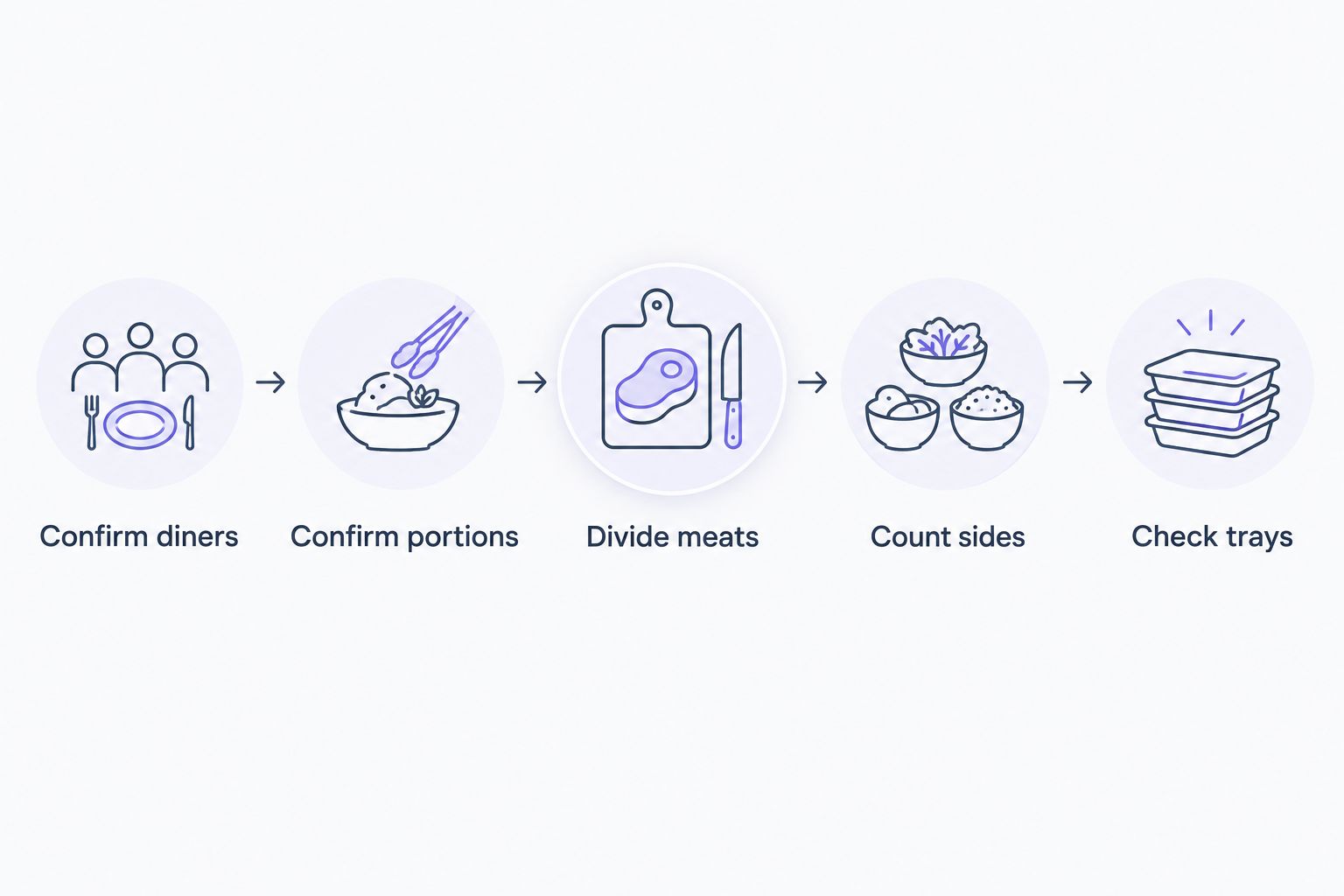
Then ask the caterer to walk through this sequence:
- Confirm diners: Agree on who is included in the food count.
- Confirm portions: Establish the cooked, edible serving basis.
- Divide meats: Allocate the meal’s meat allowance across the choices.
- Count sides: Establish coverage for each accompanying dish.
- Check trays: Translate the meal plan into the containers being ordered.
Ask who will portion the food and who will replenish it. A written quantity is easier to use when the person running the buffet understands what it is intended to serve.
Gravytraincatering provides BBQ and soul food catering for weddings, corporate events, church gatherings, and private parties across the Charlotte metro area. Use the contact page to discuss your headcount and request confirmation of the portion basis for your event.
How much extra BBQ should you order?
Name the reason for extra food before increasing the order. Unconfirmed guests, second helpings, vendor meals, and take-home plates are separate planning decisions, not a single automatic allowance.
Ask whether the caterer’s recommended quantity already accounts for the intended serving style. Adding another cushion without checking can duplicate an allowance already built into the plan.
If leftovers are a goal, say so directly. Order planned take-home portions as a separate requirement, and decide who will package and refrigerate them before the gathering begins.
How do you calculate BBQ for children?
Use the children’s actual meal plan, not an automatic fraction of every adult portion. Tell the caterer the children’s ages, whether they will eat the same menu, and whether separate meals are needed.
Keep children visible in the headcount even when their portions differ. Removing them from the count entirely hides meals that still need to be supplied.
How do you know whether trays will be enough?
Ask for each tray’s intended servings with your complete menu. A tray’s outside dimensions do not establish the amount of food inside or the portion the estimate assumes.
Confirm whether the serving estimate describes a main dish or an accompaniment. Then check whether the totals cover the same guest count across the whole meal, including guests receiving alternatives.
Keep the food safe after serving
A generous order needs a safe holding plan. USDA consumer guidance for perishable food sets hot holding at 140°F or above and cold holding at 40°F or below.
The same USDA guidance limits unrefrigerated perishable food to 2 hours, or 1 hour when the temperature is above 90°F. Those limits concern food outside safe temperature control; they are not a recommendation to leave every tray on the table until the deadline.
For an outdoor event in 2026, assign someone to check holding temperatures and handle leftovers promptly. Extra food is only useful when you have the equipment, storage, and people to manage it safely.
FAQ
How much food to order per guest for BBQ catering?
Order the caterer’s confirmed cooked, edible portion for each guest eating BBQ, with sides and separate meals counted against the guests receiving them. Confirm the portion basis before converting the order into pounds or trays.
Should I order a full serving of every meat for every guest?
No. Divide the planned meat allowance among the selected meats unless you deliberately want additional complete portions. Tell the caterer whether guests will choose a main dish or sample several.
Does a pound of bone-in BBQ feed the same as boneless meat?
No. Bone-in weight includes bones, so it is not equivalent to the same weight of cooked boneless meat. Ask for the edible yield or the intended servings.
How many ounces are in a pound of BBQ?
There are 16 ounces in 1 pound. Confirm whether that pound describes raw meat, cooked bone-in meat, or cooked boneless meat before using it to calculate portions.
Should I include vendors in my BBQ catering headcount?
Include every vendor you have agreed to feed. Identify those meals separately so the caterer knows whether they use the main menu and when they will be served.
Can vegetarian guests just eat the BBQ sides?
Do not assume BBQ sides provide a suitable vegetarian meal. Confirm ingredients and agree on a complete meal for guests who are not eating the meat.
How long can BBQ sit out at a party?
USDA guidance limits unrefrigerated perishable food to 2 hours, or 1 hour above 90°F. Keep hot food at 140°F or above and cold food at 40°F or below when holding it for service.
One last thing
Check the serving utensil against the planned portion before the buffet opens. A carefully calculated order still needs serving instructions that match it; “a serving” should mean the same thing to the caterer and the person filling plates.
Before approving your 2026 Gravytraincatering order, ask for the headcount, menu, and portion basis together in writing. That is a more useful final check than whether the number of pans sounds generous.