
Calculate your wedding catering headcount by counting every confirmed person who will eat, including the couple, children, and vendors receiving meals, then separating those people by meal type. Keep unanswered invitations outside the confirmed total, and use your catering agreement—not a guessed attendance percentage—to settle the final guarantee and any extra portions.
- How to calculate headcount for wedding catering: count confirmed diners, then separate guest meals, children’s meals, and vendor meals.
- Count people, not invitations; record each accepted plus-one separately.
- A buffet changes portion planning, not the number of people attending.
- Gravytraincatering serves wedding BBQ and soul food across the Charlotte metro area.
How do you calculate headcount for wedding catering?
Your catering headcount is the total number of confirmed people receiving food at that meal. Your guest list, seating chart, and catering order should agree about who those people are, even when the meal categories differ.
Use the BBQ catering guide for wedding planners alongside your attendance worksheet when organizing reception details.
Follow this sequence:
- Record confirmed guests. Enter each attending person by name, including each accepted plus-one. An invitation addressed to a household is not a headcount.
- Add the couple. Include yourselves if you will eat the catered meal. Do not rely on a separate wedding-party list to catch this.
- Identify children’s meals. Keep children in the attendance total, then record their meal arrangements separately.
- Add vendor meals. Check which working vendors need food, who supplies it, and when they will eat.
- Reconcile the order. Match each diner to the correct meal category, remove duplicates, and submit the agreed totals through the process in your catering agreement.
The working formula is straightforward:
Confirmed guest meals + meals for the couple not already counted + vendor meals supplied by the caterer = total catered meals.
Children belong within confirmed guest meals, not in an extra category that gets added twice. Use a separate column to describe their meals while keeping the overall attendance count intact.
Why this matters
A wedding headcount does more than tell someone how much food to prepare. It connects your seating plan, dietary requests, serving arrangements, and the meals needed by people working while everyone else celebrates.
For your 2026 wedding, keep a single master attendance list instead of reconciling separate family texts on the final day. Y’all should be thinking about the celebration, not wondering whether a cousin’s partner made it onto the dinner order.
Gravytraincatering is best for couples seeking BBQ and soul food wedding catering in the Charlotte metro area. The Salisbury-based company serves weddings, but your event’s meal categories, service arrangements, and final-count terms still need to be confirmed directly.
The practical benefit of a clean count is clarity: every person has a place in the plan. The limitation is equally important: a correct attendance total does not, by itself, specify serving quantities or confirm how special meals will be handled.
Build a worksheet that counts people only once
Give each person a separate row. Household-level tracking is useful for mailing invitations, but individual rows make meal selection and attendance changes easier to follow.
A useful 2026 wedding catering worksheet includes these fields:
| Field | What to record | What it prevents |
|---|---|---|
| Guest name | The individual attending | Counting an invitation as a person |
| Attendance status | Accepted, declined, or unanswered | Treating an unanswered invitation as confirmed |
| Meal category | Adult, child, or vendor arrangement | Combining different orders without explanation |
| Meal selection | The selection requested for that diner | Losing a choice during list updates |
| Dietary request | The specific request shared by the guest | Replacing details with a vague label |
| Event attendance | Which catered gatherings the person will attend | Using the reception count for every gathering |
| Included in total | Whether the person is already counted | Adding the same person through multiple lists |
Keep attendance status separate from meal selection. A guest who has accepted but has not chosen a meal is still attending; the missing selection needs follow-up, not removal from the headcount.
Likewise, a dietary request describes a diner already on the list. It does not create another diner or automatically mean an additional meal should be ordered.
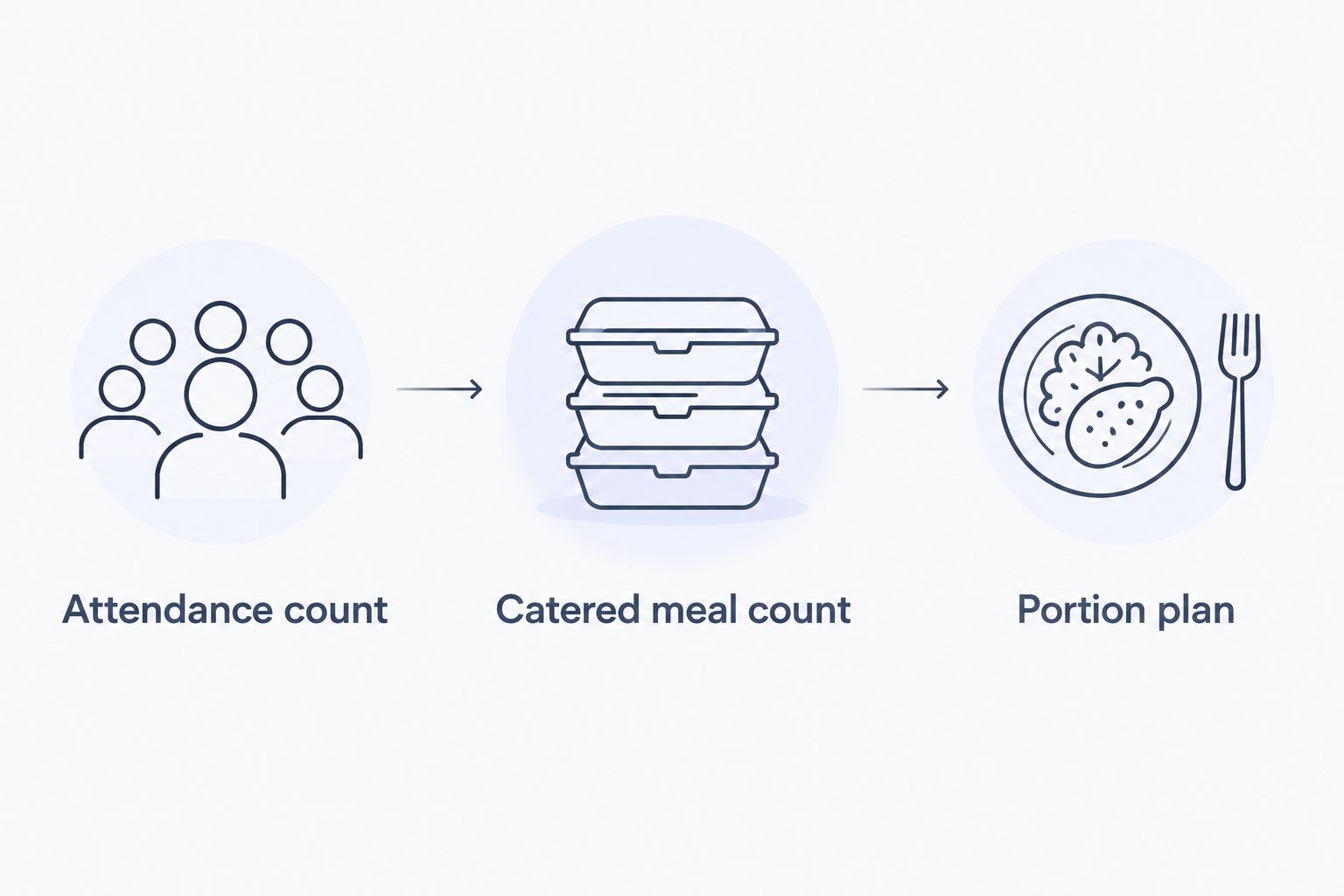
Separate attendance, meal totals, and portion planning
These totals answer different questions. Keeping them separate stops a reasonable food-planning decision from turning into an inaccurate guest list.
| Planning total | Best for | Advantage | Limitation |
|---|---|---|---|
| Attendance count | Seating and identifying everyone present | Shows who will attend | Includes people whose food arrangements can differ |
| Catered meal count | Ordering the meals the caterer will supply | Connects people to the food order | Must distinguish meal types and service times |
| Portion plan | Deciding quantities for the selected menu | Addresses serving needs | Does not replace a confirmed attendance count |
Count 1 person as 1 attendee, even when that person needs a different meal. If the same guest attends a reception and a separately catered brunch, that is 2 meals across separate events, not another reception guest.
For a buffet, give the caterer the actual diner count and discuss portions separately. Do not turn a desire for generous servings into fictional guests; it makes the attendance record harder to use.
Count children without guessing at meal equivalents
Put every attending child on the master list. Then ask the caterer how children’s meals, shared meals, and children not receiving catered food should appear on the order.
Do not automatically convert children into fractions of adult guests. A child’s age alone does not tell you what meal the family will request or how the caterer records that meal.
Best for families with children: named child entries with confirmed meal arrangements. This approach makes seating and food requests visible; its drawback is that you must follow up with parents rather than filling gaps with assumptions.
Ask families to confirm the arrangement in plain language. Record whether the child needs a catered meal, along with any selection or dietary request, and keep seating needs in their own field.
Include vendor meals without adding the whole crew blindly
Review the meal requirements in each vendor agreement. Ask the lead contact which team members will be present during food service and which need a meal supplied through your catering order.
A company name is not a person count. Record the confirmed crew members who need food, then check that your planner has not already included those meals elsewhere.
Best for a working vendor team: a separate vendor-meal subtotal tied to the same master list. It makes staff meals visible without mixing them into guest seating; the extra task is confirming service timing and meal arrangements with the people involved.
Also establish who receives the meals and where they will eat. A correct subtotal is not enough if nobody knows how the food reaches the team while the reception continues.
Why wedding catering headcounts vary
Your confirmed count changes when the people or meal arrangements change—not because a universal attendance percentage says it should. These are the details to resolve before finalizing your 2026 catering order:
- RSVP status: Accepted invitations belong in the confirmed total; unanswered invitations belong on a follow-up list.
- Plus-ones: Count an accepted accompanying guest individually, rather than assuming every invitation includes another diner.
- Children’s arrangements: Confirm which children receive catered food and how those meals should be recorded.
- Vendor requirements: Include the confirmed working team members whose meals your caterer will supply.
- Event schedule: Build separate totals for the reception and any other catered gatherings.
- Attendance changes: Record cancellations and additions without losing track of what has already been submitted.
These factors change the information you send. Your agreement determines how that information affects the final order, including deadlines and the handling of changes.
What should you do about unanswered RSVPs?
Keep unanswered invitations outside your confirmed catering total and contact those guests directly. An invitation that has not received a response is unresolved, not an acceptance or a decline.
For your 2026 RSVP follow-up, ask for a definite attendance answer and the required meal details together. That avoids a second round of messages just to establish what an attending guest will eat.
If someone still has not replied when your final count is due, discuss the situation with your planner and caterer before submitting the guarantee. Do not replace a missing answer with an invented attendance rate.
Maintain a clearly marked pending list until each decision is resolved. Once a person moves into the confirmed total, remove them from pending so they cannot be added again during a later update.
Should you add extra meals to the headcount?
Keep any agreed extra portions separate from the named guest count. Ask your caterer how the selected menu, serving arrangement, and final-count terms address food quantities and late changes.
An extra-food discussion should answer a specific concern. Tell the caterer whether you are worried about unresolved invitations, additional vendor meals, or serving quantities rather than asking for an unexplained cushion.
Use the catering contact page to discuss your wedding date, location, confirmed diners, pending responses, and meal categories. Bring the worksheet so the conversation starts with a usable count.
Talk Through Your Wedding Headcount
Share your confirmed diners, children’s meals, vendor needs, and unresolved RSVPs.
How do you check the final count before submitting it?
Read the completed order against your attendance list, not against memory. Check the couple, wedding party, accepted plus-ones, children, and vendor meals explicitly.
Then check the categories. Each person receiving catered food should appear in the correct meal subtotal, and each subtotal should describe what the caterer is being asked to provide.
Before you send your 2026 final count:
- Remove declined guests from the active meal order.
- Resolve duplicate names across household and wedding-party lists.
- Follow up on accepted guests with missing meal selections.
- Confirm dietary requests directly rather than rewriting them from memory.
- Match vendor meals to confirmed team requirements.
- Label each separately catered event clearly.
- Save the submitted version and the caterer’s confirmation together.
Submit a dated version, not an unlabeled screenshot. If the count changes afterward, identify the specific additions or removals and ask for confirmation that the change has been accepted.
FAQ
Do the bride and groom count in the wedding catering headcount?
Yes, include the couple when they will eat the catered meal. Check whether they are already on the master list before adding them separately.
Do I count children as full guests for wedding catering?
Count every attending child as a person, then confirm the child’s meal arrangement with the caterer. Do not assume a child equals a fraction of an adult meal.
Should wedding vendors be included in the catering count?
Include vendors whose meals will be supplied through your catering order. Confirm the required crew meals from the vendor agreements and team contacts.
How do I calculate a wedding buffet headcount?
Use the confirmed number of people eating the buffet, with children’s and vendor arrangements identified separately. Discuss serving quantities without inflating the named guest count.
What percentage of wedding guests should I assume will not come?
Use actual responses for your final catering count instead of assuming a nonattendance percentage. Follow up with unanswered guests and resolve pending decisions before submitting the guarantee.
Does a guest with a dietary request count as an extra meal?
A dietary request does not create an extra guest. Record the request against the attending person and confirm how the caterer will fulfill it.
Can I change my catering headcount after I submit it?
Your catering agreement determines how changes are handled after submission. Ask the caterer to confirm any accepted revision in writing.
What should I send a BBQ wedding caterer with my headcount?
Send the wedding date, location, confirmed diner total, meal categories, dietary requests, and vendor-meal needs. For Gravytraincatering wedding BBQ and soul food catering, discuss those details directly rather than assuming a particular meal arrangement.
One last thing
The seating chart is a useful cross-check, but it is not automatically your catering order. Vendor meals can sit outside guest tables, while someone attending part of the celebration can have a separate food arrangement.
Before you close the worksheet, ask: Can every catered meal be traced to a named person or a clearly confirmed vendor requirement? If the answer is yes, you have a count you can explain—and a much clearer conversation about feeding your people well.