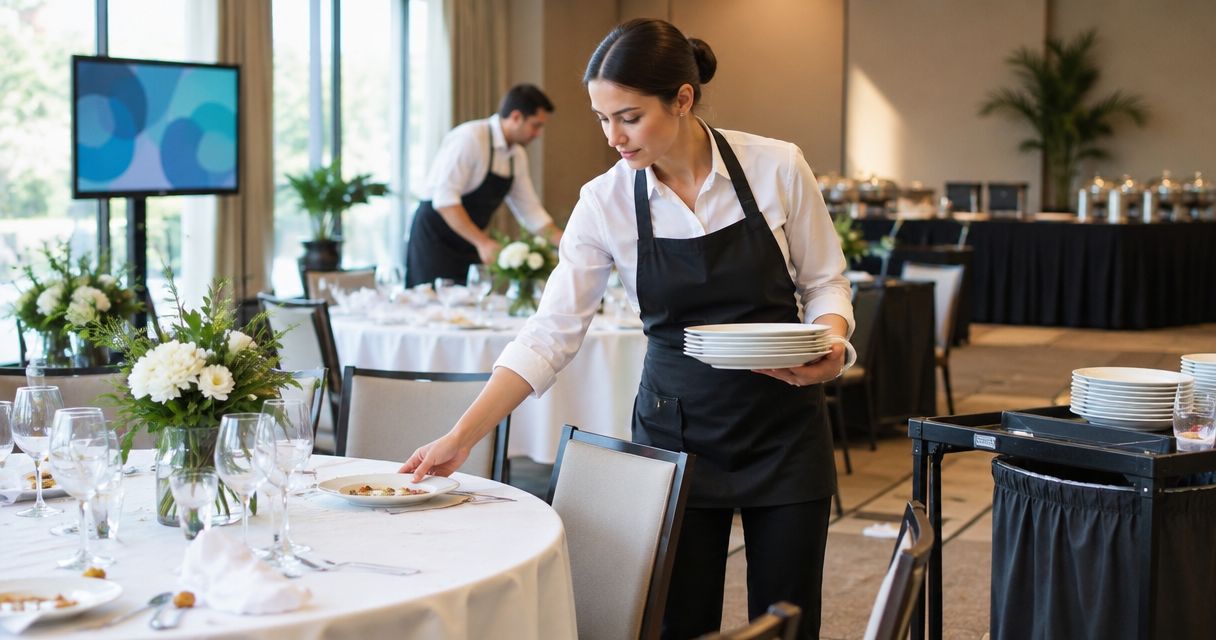
Catering staff clean up after an event when cleanup is included in your service agreement; hiring a caterer does not automatically include cleaning the entire venue. Confirm who clears dishes, handles food-service equipment, removes trash, and completes the venue’s closing checklist before you book your 2026 event.
- Does catering staff clean up after the event? Only the cleanup duties agreed to are part of the job.
- Food-service cleanup and whole-venue cleaning are separate responsibilities; assign both before your event.
- DG&G Gravy Train Catering serves BBQ and soul food gatherings; confirm your event’s cleanup scope directly.
- Name who handles dishes, trash, leftovers, rentals, and the final venue walkthrough.
Does catering staff clean up after the event?
Yes, when your agreement includes it—but clearing the buffet is not the same as cleaning the building. Your booking should identify the work, the areas covered, and when the staff’s responsibility ends.
For BBQ and soul food events around Salisbury and the Charlotte metro area, contact the catering team with your venue’s cleanup requirements before agreeing to a service scope. Send the actual checklist rather than asking only whether cleanup is included.
Use this comparison to separate the jobs. It is a planning checklist, not a statement of any particular caterer’s services.
| Cleanup task | What to confirm | What not to assume |
|---|---|---|
| Guest dishes | Who clears plates, cups, and utensils from dining tables | Serving food includes continuous table clearing |
| Buffet breakdown | Who removes serving utensils, food pans, and food-service equipment | Taking away equipment includes wiping every nearby surface |
| Kitchen cleanup | Which sinks, counters, appliances, and floors must be cleaned | A caterer cleans areas the team did not use |
| Trash handling | Who bags waste, replaces liners, and moves bags to the approved disposal point | Bagging trash includes hauling it off-site |
| Venue reset | Who returns tables, chairs, linens, and decorations | Food-service staff handle furniture and event décor |
| Final inspection | Who checks the space against the venue’s requirements | The caterer’s departure means the venue has accepted the room |
Why this matters
After a good meal, y’all should know whether you are saying goodbye to guests or starting a cleanup shift. An unclear agreement leaves those jobs unsettled until the room is empty.
For your 2026 event, treat cleanup as part of the event plan, not a favor to request at closing time. The menu tells you what guests will eat; the cleanup scope tells you what work remains afterward.
Which catering setup fits your cleanup needs?
Choose a service arrangement by the work you want covered, then confirm that work in writing. Service labels alone do not establish cleanup duties.
The arrangements below describe choices to discuss with a provider. They are not packages offered by DG&G Gravy Train Catering.
| Arrangement | Best for | Advantage | Limitation to resolve |
|---|---|---|---|
| Food delivery without on-site service staff | Hosts with a separate serving and cleanup crew | Keeps food delivery separate from event staffing | You must assign serving, clearing, and closing duties elsewhere |
| Staffed meal service | Hosts who want help during the meal | Lets you agree on serving and clearing responsibilities together | Staffed service does not establish a whole-venue cleaning obligation |
| Catering plus a separately assigned cleanup crew | Events with detailed room-reset requirements | Gives food service and venue cleaning distinct owners | Requires a clear handoff so neither crew assumes the other is responsible |
Food delivery: best for hosts with a cleanup crew
If no staff remain on-site, assign the entire after-meal process before delivery. Someone must monitor the serving area, collect dishes, manage leftovers, and close the room.
Choose food delivery only when your serving and cleanup responsibilities are already covered. Do not build your closing plan around delivery personnel returning unless that return visit is explicitly arranged.
Staffed service: best for agreed meal-service support
With staffed service, specify whether the team clears dining tables during the meal, breaks down the buffet afterward, or does both. Also establish whether staff stay through the event’s end or leave when meal service ends.
The advantage is an agreed point of contact for food-service work. The limitation is scope: assistance around the meal does not automatically extend to bathrooms, decorations, parking areas, or furniture.
Separate cleanup support: best for a detailed venue reset
A separate cleanup crew makes sense when your closing checklist extends beyond food service. Assign the handoff between crews so equipment removal, floor cleaning, and furniture reset happen in a workable order.
Use a written division of duties, not overlapping promises to tidy up. A separate crew still needs access instructions, disposal directions, and a named person who can approve the finished work.
Why catering cleanup responsibilities vary
Your 2026 cleanup plan should reflect the event you are actually hosting. These are the practical details to resolve with your caterer and venue—not assumptions about what a provider includes.
- Service scope: Identify whether you are arranging food delivery, on-site meal service, or additional closing work.
- Venue requirements: Share the room’s cleaning and reset checklist before the service agreement is finalized.
- Equipment ownership: Separate the caterer’s equipment from rented items and supplies you bring yourself.
- Event timing: Distinguish the end of food service from guest departure and the venue’s access deadline.
- Disposal arrangements: Identify the permitted trash location and who moves waste there.
- Use of the space: List the dining room, serving area, kitchen, outdoor areas, and any other spaces requiring attention.
A church fellowship hall, an office gathering, and a wedding reception can have different closing instructions. Ask about the actual room and booking rather than relying on what happened at a previous event.
Set up 3 cleanup handoffs before event day
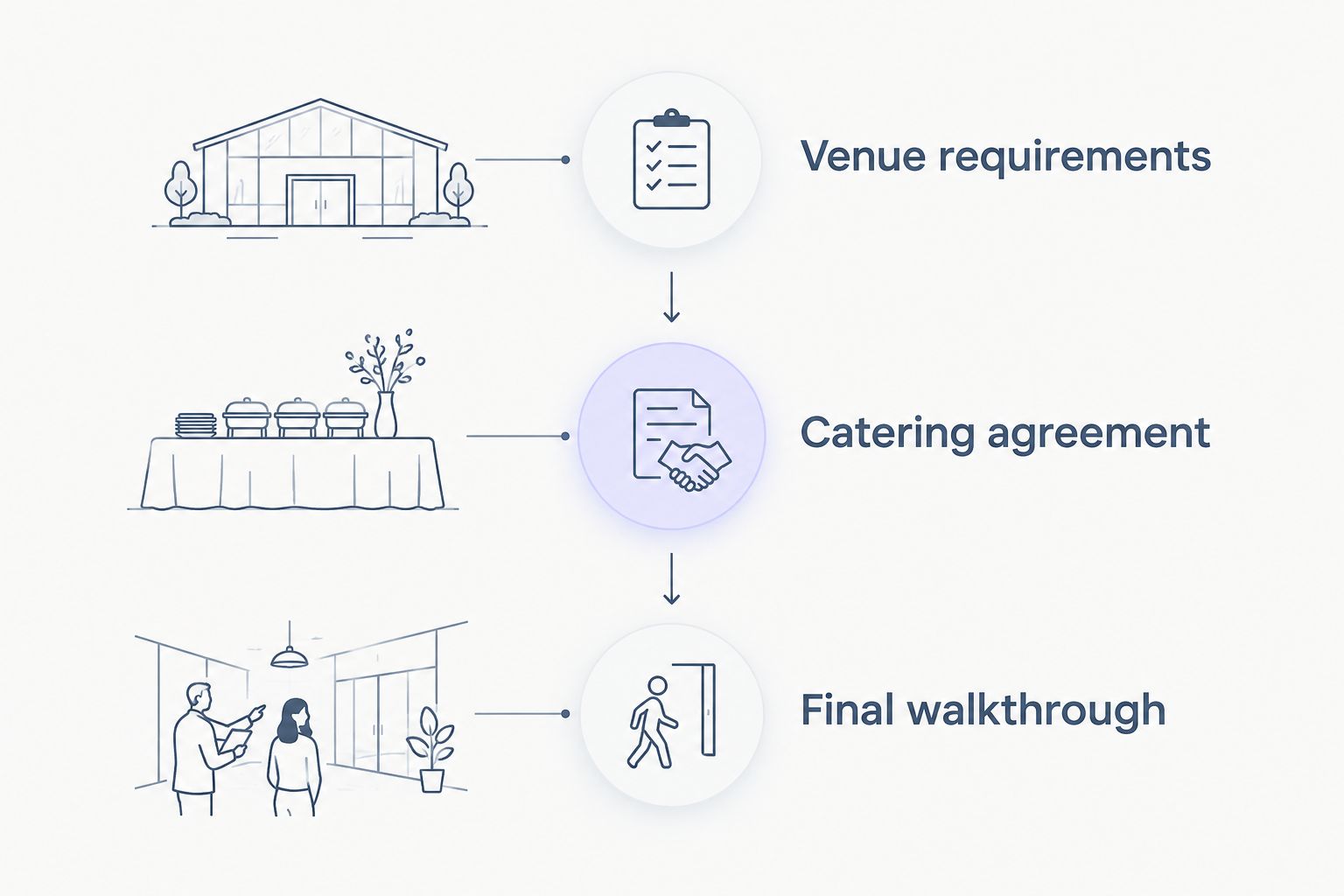
A dependable cleanup plan has 3 handoffs: from the venue to the host, from the host to the catering team, and from the closing crew back to the venue. Each handoff should transfer clear instructions, not just a general expectation that someone will clean.
Venue requirements
Get the venue’s closing checklist and identify who has authority to accept the finished space. Ask whether the room must be restored to a particular layout and whether cleaning supplies or waste facilities are provided.
Do not assume access to a kitchen includes permission to use every appliance or disposal area. Pass the venue’s instructions to everyone responsible for food service or cleanup.
Catering agreement
Turn the venue checklist into named responsibilities. Put food-service duties in the catering discussion and assign everything outside that scope to the host, venue team, rental provider, or a separate cleaner.
Ask for the agreed duties to appear in the written booking details. A conversation helps clarify expectations; a written scope gives everyone the same reference on event day.
Final walkthrough
Name the person who stays until the closing checklist is checked. That person should know where equipment belongs, which items are awaiting collection, and how the venue wants the room left.
Arrange the walkthrough while the people responsible for unfinished work are still present. Finding an overlooked task after everyone has departed leaves the host with fewer ways to resolve it.
Put 4 written assignments in your 2026 event plan
Keep the closing plan simple enough that a helper can follow it without calling you during the last dance. Use 4 written assignments, each with a named owner and a clear finish point.
- Dining area: Assign plate collection, table wiping, and any floor work required by the venue. State whether clearing happens during the meal, afterward, or both.
- Food and equipment: Assign leftover decisions, serving-area breakdown, and the handling of food-service equipment. Identify anything that must remain for later collection.
- Waste and recycling: Assign collection, bagging, sorting where required, and transport to the approved disposal location. Identify who handles waste left after the catering team departs.
- Room reset: Assign linens, decorations, furniture, and the closing walkthrough. Make sure personal belongings are not mixed with items intended for disposal.
Include the responsible person’s name alongside each assignment. Writing “family will help” leaves the job open; naming a coordinator gives helpers someone to follow.
How do you confirm cleanup with your caterer?
Send your caterer a short description of the event, the venue instructions, and the duties you want covered. For a 2026 booking, ask for confirmation alongside your service details rather than leaving it until event week.
DG&G Gravy Train Catering is best suited to hosts seeking BBQ and soul food catering in the Charlotte metro area. Its stated event types include weddings, corporate events, church gatherings, and private parties; confirm cleanup arrangements for your specific booking rather than treating that event experience as a cleanup guarantee.
Use direct questions during the discussion:
- Which dining and serving areas will your staff clean?
- Will staff collect guest plates and cups, or only break down the food station?
- Who handles trash after your team leaves?
- Who packs leftovers, and who supplies containers?
- What equipment stays for later collection?
- When does the team’s on-site responsibility end?
Ask what remains for you to do after the catering team leaves. That question exposes the boundary more clearly than a simple request for cleanup.
Plan Your Catering Details
Share your venue checklist and ask which food-service and cleanup duties your booking will include.
Does catering cleanup include taking out the trash?
Taking out trash is included only when the agreed scope assigns it. Specify whether the job means collecting waste, tying bags, moving them to a venue dumpster, or removing them from the property.
Those are different finish points. If guests remain after meal service, assign whoever handles the additional waste they generate.
Does catering cleanup include packing leftovers?
Packing leftovers belongs in the service discussion, not in an assumption about cleanup. Confirm who decides what to keep, who provides containers, and who receives the food.
Keep food handling separate from table clearing. Ask the catering team for safe handling instructions, and assign someone to follow them rather than leaving food unattended while the room is reset.
Does the venue still need to inspect the room?
The venue’s acceptance process is separate from the catering team finishing its assigned work. Arrange 2 separate approvals in your plan: confirmation that the catering duties are complete and confirmation that the venue’s closing requirements are satisfied.
The same person can coordinate both checks, but the checks answer different questions. Equipment can be removed while decorations or furniture still need attention.
FAQ
Does catering staff clean up after the event automatically?
No. Catering staff are responsible for the cleanup duties included in the agreed service scope, not automatically for the entire venue. Confirm dishes, serving areas, trash, and closing responsibilities before booking.
Will catering staff clear plates while guests are still eating?
Plate clearing during the meal must be part of the agreed service. Ask whether staff clear dining tables throughout the event or only handle the serving area after meal service.
Does full-service catering mean I do not need a cleaner?
The full-service label alone does not establish that every cleaning task is covered. Compare the written catering scope with your venue’s closing checklist and assign any remaining work.
Who cleans tables and chairs after a catered wedding?
The person or team assigned that work in your event plan cleans tables and chairs. Confirm table wiping, linen removal, chair handling, and furniture reset separately rather than treating them as a single task.
Do caterers take away rented plates and linens?
Rental handling depends on the arrangements you make with the caterer and rental provider. Identify who collects, prepares, stores, and returns each rented item, including anything awaiting later pickup.
What should I ask a caterer about cleanup for a church gathering?
Ask which food-service areas the catering team will clean and which fellowship-hall duties remain with your group. Share the church’s kitchen, trash, and room-reset instructions before agreeing to the service scope.
How do I confirm cleanup with DG&G Gravy Train Catering?
Ask DG&G Gravy Train Catering to confirm the cleanup duties included in your specific booking. Share your venue checklist and request written confirmation of table clearing, food-service breakdown, trash handling, and the team’s departure point.
One last thing
Write down what clean means before anyone starts cleaning. An empty buffet, cleared tables, and a room ready for its next booking are different results.
For your 2026 gathering, attach the venue checklist to your closing plan and name the person who checks it. That leaves less room for confusion—and lets y’all focus on the meal and the people gathered around it.