Yes, BBQ catering can be delivered without on-site staff when you arrange drop-off service and assign someone at your event to receive, hold, and serve the food. Delivery does not automatically include buffet setup, equipment, replenishment, or cleanup. For a 2026 gathering, confirm those responsibilities before booking so y’all know who takes over when the driver leaves.
- Can BBQ catering be delivered without on site staff? Yes—drop-off service leaves food handling and serving with your event team.
- DG&G Gravy Train Catering serves BBQ and soul food events; confirm delivery arrangements directly before booking.
- Choose drop-off catering when you have a designated food lead, suitable holding equipment, and a cleanup plan.
- Choose staffed service when you need the caterer to manage the buffet throughout your event.
For Salisbury and Charlotte-area celebrations, DG&G Gravy Train Catering is a BBQ and soul food caterer serving weddings, corporate events, church gatherings, and private parties. Ask specifically about an unstaffed delivery rather than assuming every catering order includes the same service.
Can BBQ catering be delivered without on-site staff?
Yes. The deciding issue is who manages the food after delivery, not whether BBQ can travel to your venue. A drop-off arrangement transfers the agreed food and supplies to your designated recipient; any additional setup or equipment needs to be spelled out.
Use this comparison when discussing the service you want. These are planning models, not a statement of any particular caterer’s package inclusions.
| Service arrangement | Best for | Main advantage | Main limitation |
|---|---|---|---|
| Drop-off catering | Hosts with a designated food lead and a straightforward meal schedule | Your event team controls service after delivery | Your team handles food holding, replenishment, and cleanup unless otherwise agreed |
| Delivery with agreed setup | Hosts who need the buffet arranged before taking over | Setup responsibilities can be assigned before arrival | Setup does not mean staff remain for the meal |
| Staffed catering | Hosts who want food-service tasks assigned to the caterer | The agreed service team manages specified meal duties | Staffing roles, service hours, and cleanup still need clear boundaries |
Best for a host who wants to manage the meal: drop-off catering. Best for a host who wants to stay out of food service: an agreed staffed arrangement. Neither choice removes the need to check venue rules and food-handling responsibilities.
Why this matters
An unstaffed delivery still leaves plenty to do. Someone must receive the order, check it against the written menu, put food into suitable holding conditions, and keep the serving area orderly.
That distinction matters when your volunteer crew is also greeting church members, running a company presentation, or helping with a wedding ceremony. A tray of savory BBQ does not refill itself, and the person giving the welcome speech cannot watch the buffet at the same time.
For your 2026 event plan, separate food preparation from event service. Ordering the meal and assigning the meal’s caretakers are different decisions.
Drop-off catering: best for a host-managed meal
Choose drop-off catering when you have someone ready to take responsibility at the handoff. A church supper, office lunch, or family gathering can use this arrangement when the venue, meal schedule, and helpers support it.
The advantage is a clear handoff: the caterer provides the agreed order, then your team manages the meal. You can organize the serving line around your gathering rather than expecting a caterer’s crew to remain on-site.
The drawback is the work that stays with you. Receiving trays is only the start; you also need a plan for safe holding, clean serving utensils, guest questions, spills, and leftovers.
Choose drop-off only when someone has accepted the food-service job—not when everyone assumes somebody else will do it. If your helpers need to leave during the meal, assign a replacement before service begins.
Delivery with setup: best for a prepared handoff
Ask about delivery with setup when you need help getting the serving area ready but do not need attendants throughout the gathering. Specify what setup means: placing trays, arranging equipment, identifying dishes, or something else entirely.
Its advantage is a more defined starting point for your host team. Its limitation is just as important: once the setup team departs, the buffet still needs attention.
Do not treat the word “setup” as a promise of equipment, fuel, serving utensils, or later collection. Put each requested task in the written agreement, including who removes or returns any reusable items.
Staffed catering: best for delegated food service
Choose a staffed arrangement when you need someone other than your guests or volunteers to manage food service. Weddings with ceremony duties, events with overlapping activities, and meals with repeated replenishment need an explicit staffing discussion.
The benefit is an assigned service team for the duties you agree on. The limitation is that “staffed” still does not define every task: clearing guest tables, washing venue dishes, removing trash, and packing leftovers are separate responsibilities to confirm.
Request the work you need by name. Asking who checks the buffet and who cleans the serving area gives you a clearer answer than simply asking whether staff are included.
Why the right delivery arrangement varies
Your event’s needs determine whether an unstaffed handoff is practical. Review these factors before choosing:
- Venue access: Confirm where delivery enters, where trays go, and who opens the building or receiving area.
- Serving schedule: Match the handoff to your holding plan, especially when guests will eat after a ceremony or presentation.
- Food-holding equipment: Identify how hot dishes stay hot and cold dishes stay cold after delivery.
- Available helpers: Name the people responsible for receiving, replenishing, clearing spills, and closing the buffet.
- Guest needs: Confirm ingredient information and a serving plan for guests with allergies or dietary restrictions.
- Venue responsibilities: Check rules for warming equipment, food handling, waste disposal, and access to refrigeration.
An early delivery is not automatically a useful delivery. It only works when your receiving team and safe-holding arrangements are ready at that time.
How do you organize BBQ delivery without on-site staff?
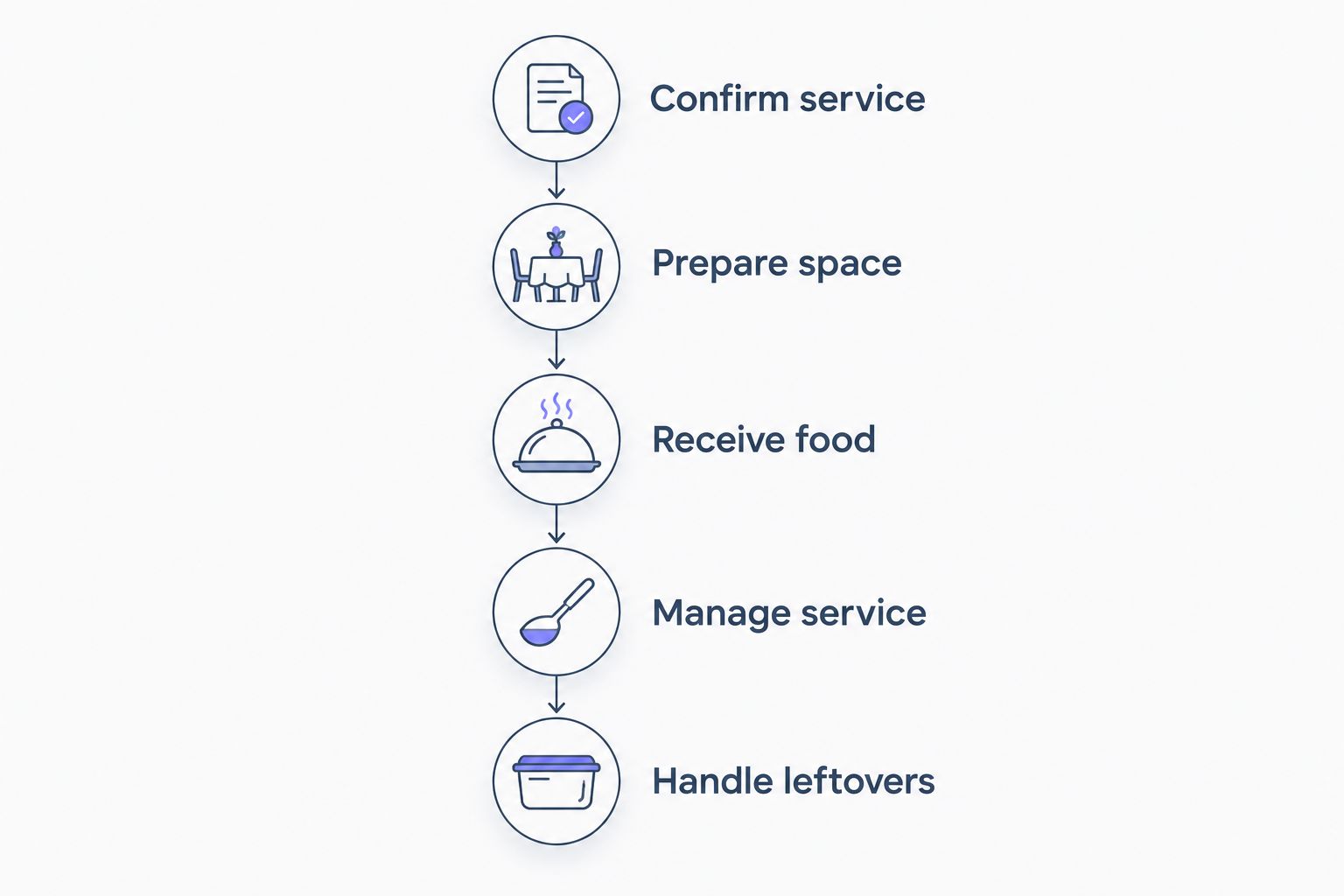
Build your 2026 delivery plan around a clear sequence. Send the same instructions to the caterer, venue contact, and person receiving the meal so conflicting directions do not reach the driver.
- Confirm service. Ask whether your requested arrangement is delivery only, delivery with setup, or staffed service. Record what happens before the caterer leaves.
- Prepare space. Clear a receiving area and serving surface. Confirm access to suitable holding equipment, refrigeration, handwashing, and waste disposal as needed.
- Receive food. Have the designated recipient meet the delivery, check the order, and review any handling instructions. Do not make unattended delivery your default plan.
- Manage service. Assign someone to monitor holding conditions, replace serving utensils when needed, and replenish dishes without losing track of food already served.
- Handle leftovers. Decide who refrigerates eligible leftovers, discards food that has exceeded safe limits, and clears the serving area.
A named person should own each step, even when the same helper handles several jobs. “The family will take care of it” is not a useful handoff instruction unless the family knows who is doing what.
What should go in the written delivery instructions?
Include the event date, venue address, delivery entrance, recipient’s name, contact details, and agreed arrival window. Add the serving location if it differs from the receiving point.
List the food and every agreed nonfood item separately. Plates, napkins, cutlery, serving utensils, labels, warming equipment, and takeaway containers should not disappear inside a vague reference to “everything needed.”
Finish with the handoff boundary: who arranges the food, when the delivery team leaves, and who handles equipment afterward. Clear responsibilities protect your meal plan better than assumptions about what catering usually includes.
Plan your BBQ catering handoff
Share your venue, meal schedule, and service needs before choosing a delivery arrangement.
How do you keep delivered BBQ safe without staff?
Use food-safety limits, not the way a tray looks or smells. USDA consumer guidance for perishable food calls for keeping hot food at 140°F or above and cold food at 40°F or below.
USDA also advises refrigerating perishable food within 2 hours, or 1 hour when temperatures are above 90°F, unless it is being kept under suitable hot or cold holding conditions. These are general consumer limits; follow the caterer’s handling instructions and any applicable venue or local requirements as well.
For your 2026 gathering, build those limits into the receiving and serving plan:
- Use a food thermometer rather than guessing from steam or the outside of a container.
- Confirm that the equipment you plan to use is suitable for holding the delivered dishes.
- Keep backup portions under appropriate temperature control rather than putting everything out at once.
- Keep track of time when food is outside safe hot or cold holding conditions.
- Refrigerate suitable leftovers promptly in shallow containers; discard food that has exceeded safe limits.
A warming setup is not a substitute for checking food temperature. If nobody can monitor the food, change the service plan rather than leaving the buffet unattended.
For more on the time-and-temperature decision, read how long BBQ catering can sit out safely.
Can you have BBQ delivered for a wedding without servers?
Yes, a wedding can use unstaffed BBQ delivery when the venue permits the arrangement and an assigned team manages the meal. The couple, wedding party, and ceremony helpers should not be the assumed buffet crew.
Ask who receives the food during photographs, who opens the serving line, and who handles the end of dinner. Choose staffed service when you want those duties kept off your family’s event-day list.
Does BBQ delivery include plates, utensils, and cleanup?
BBQ delivery includes only the supplies and tasks stated in your agreement. Confirm guest cutlery, serving utensils, napkins, equipment, and cleanup individually instead of treating them as automatic inclusions.
Cleanup also needs a definition. Clearing food trays is different from collecting guest plates, washing dishes, or taking trash to the venue’s disposal area.
Can you leave delivered BBQ out for guests arriving later?
Yes, you can serve later arrivals if you maintain safe holding conditions and manage the food throughout the serving period. Hot perishable food should stay at 140°F or above, and cold perishable food at 40°F or below, under USDA consumer guidance.
Do not keep an unattended tray on the table simply because another group is expected. Put the later serving into the original holding plan.
FAQ
Can BBQ catering be delivered without on site staff?
Yes, BBQ catering can be delivered without on-site staff through an agreed drop-off arrangement. Your event team then takes responsibility for receiving, safe holding, serving, and cleanup unless the agreement assigns those tasks elsewhere.
What's the best catering arrangement if I want to enjoy my party?
Staffed catering is the better fit when you want food-service duties assigned to the caterer rather than your family or volunteers. Confirm the exact duties and service period in writing.
Does DG&G Gravy Train Catering provide unstaffed delivery?
Confirm unstaffed delivery directly with DG&G Gravy Train Catering for your event. Specify your venue, meal schedule, requested setup, and who will receive the food.
Do I need someone present when BBQ catering arrives?
Yes, arrange for a designated recipient to meet the delivery and accept responsibility for the food. That person should know the order, serving location, and holding plan.
How hot should delivered BBQ stay before serving?
Hot perishable food should stay at 140°F or above under USDA consumer guidance. Use a food thermometer and suitable holding equipment rather than judging temperature by appearance.
How long can perishable catering food stay out without temperature control?
USDA consumer guidance sets a 2-hour limit, reduced to 1 hour when temperatures are above 90°F. Refrigerate suitable food promptly or discard it once it has exceeded those limits.
Can church volunteers manage a delivered BBQ buffet?
Yes, church volunteers can manage a delivered buffet when the venue permits it and volunteers have clear receiving, holding, serving, and cleanup duties. Make sure those helpers are available throughout the meal, not just when delivery arrives.
One last thing
The most useful question is not “Will someone stay?” It is “Who takes responsibility when the driver leaves?” Write that person’s name into your 2026 event plan, alongside the food-holding instructions and cleanup assignment.
DG&G Gravy Train Catering serves BBQ and soul food gatherings across the Charlotte metro area from Salisbury. Bring your delivery and staffing questions to the planning conversation so the arrangement matches the celebration y’all want to host.