Yes, BBQ catering can work at an outdoor event without power when the caterer has an approved way to keep hot food hot, cold food cold, and hands and equipment clean. The catch is that no electricity does not mean no utilities: your setup still needs safe water, temperature control, suitable lighting, and permission for any fuel-burning equipment.
- Can BBQ catering work at an outdoor event without power? Yes, with safe holding, water, and venue approval.
- FDA Food Code holding temperatures are 135°F or above for hot food and 41°F or below for cold food.
- Gravytraincatering serves BBQ and soul food catering clients across Salisbury and the Charlotte metro area.
- Confirm the equipment plan before booking; a catering menu alone does not establish off-grid capability.
Can BBQ catering work at an outdoor event without power?
Yes—but the service plan must work without an outlet from arrival through cleanup. Cooking is only part of that plan. Food transport, buffet holding, handwashing, serving, and leftovers all need attention.
For your 2026 event, distinguish between food cooked elsewhere and food cooked at the venue. A caterer bringing prepared food has different equipment needs from a crew cooking onsite. Neither arrangement automatically solves refrigeration or sanitation.
When discussing Gravytraincatering BBQ and soul food catering, describe the site as having no electricity from the first inquiry. Ask whether the proposed service can operate under those conditions; do not assume an outdoor event package includes independent power or non-electric holding equipment.
| Service approach | Best for | Advantage | Limitation to resolve |
|---|---|---|---|
| Prepared food with insulated transport and holding | A defined meal service without onsite cooking | Separates cooking from the event site | Insulation alone does not prove safe temperatures throughout service |
| Prepared food with approved fuel-heated holding | A hot buffet where the venue permits the equipment | Keeps electrical outlets out of the hot-holding plan | Requires fuel approval, safe placement, and temperature checks |
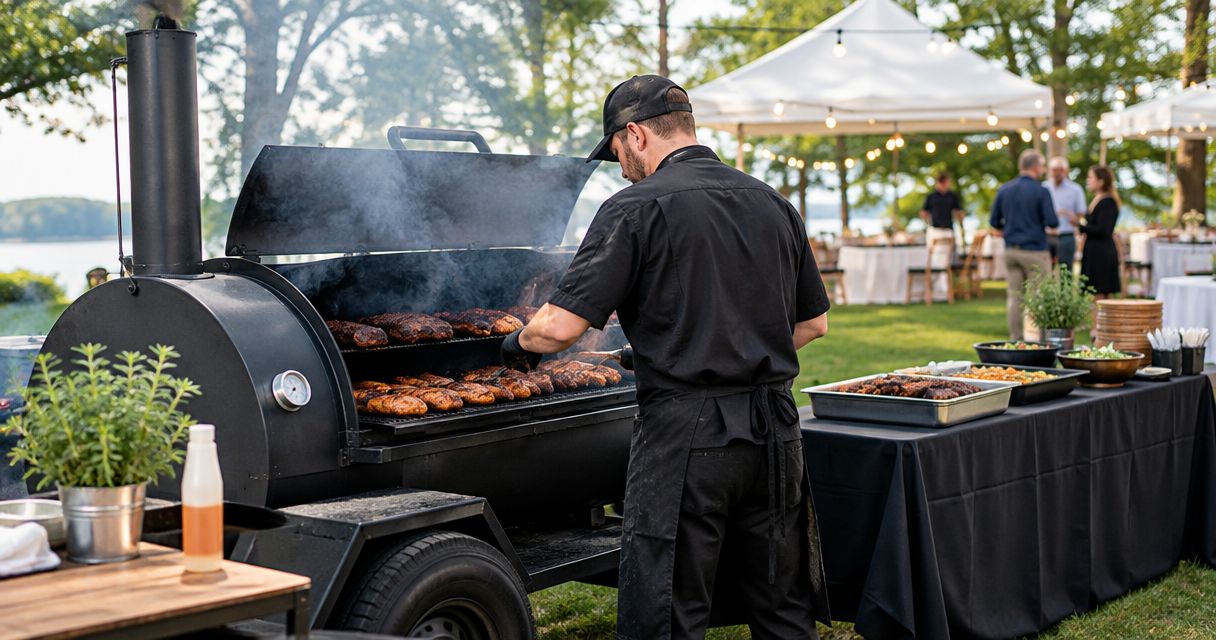
| Onsite cooking with approved non-electric equipment | Events where cooking is part of the gathering | Allows food preparation at the venue | Adds fire, food-preparation, water, and operational requirements |
These are planning approaches, not confirmed offerings from any particular caterer. Choose the approach your caterer can document and your venue allows.
Why this matters
A shady pavilion can feel comfortable while food sits outside its safe holding temperature. Likewise, a covered pan can look ready to serve without actually staying hot enough. Appearance, shade, and steam are not substitutes for a food thermometer.
For 2026 planning, the FDA Food Code provides the relevant food-service benchmark: hot-held foods requiring temperature control stay at 135°F or above, while cold-held foods stay at 41°F or below. Local authorities determine the requirements that apply to your event.
Your job as host is not to improvise a commercial kitchen. It is to make sure someone owns each part of the food-service plan before guests arrive.
Prepared food: confirm transport and holding together
Bringing cooked BBQ to the venue avoids onsite cooking, but it does not remove the need for temperature control. Ask how food travels, where it waits, and what happens when each serving pan reaches the table.
Insulated carriers help limit temperature changes. Their usefulness depends on the food's starting temperature, the equipment, outdoor conditions, and how often the carrier opens. Do not accept a blanket promise that a closed box keeps every dish safe all afternoon.
Best for a defined meal service: prepared food with a documented transport-and-holding plan. The advantage is less cooking activity at the venue; the limitation is that transport equipment must also support the actual service schedule.
Ask who measures food temperatures and what happens if a reading falls outside the required holding range. That answer matters more than whether the container feels warm to your hand.
Fuel-heated holding: get permission before planning the buffet
Fuel-heated buffet equipment can hold hot food without drawing electricity, but the venue must permit the proposed equipment. Tell the venue exactly what the caterer intends to use rather than asking only whether BBQ is allowed.
Holding equipment is not a substitute for proper cooking or reheating. Food needs to enter the service setup ready for its intended holding method, following the caterer's food-safety procedures.
Best for an approved hot buffet: fuel-heated holding with trained supervision. The advantage is independence from electrical outlets; the limitation is the need to manage fuel, hot surfaces, wind exposure, and guest access.
Keep the serving layout separate from play areas and busy walking routes. Ask the caterer and venue to agree on placement rather than leaving that decision until unloading begins.
Onsite cooking: plan beyond the grill
A non-electric cooking appliance does not make an entire catering operation independent of electricity. The crew still needs a plan for raw ingredients, clean utensils, handwashing, cooked food, waste, and safe movement around the cooking area.
Best for an event built around onsite cooking: an approved cooking setup with the supporting food-service facilities. Its advantage is cooking at the gathering; its limitation is the additional space and coordination required.
Never operate generators or charcoal-burning equipment inside an enclosed tent or other enclosed space. Follow manufacturer instructions and applicable fire requirements for equipment placement and clearances.
For a 2026 outdoor wedding, church gathering, or company picnic, confirm whether the venue treats cooking equipment differently from buffet warming equipment. Permission for one does not establish permission for the other.
Why an outdoor catering setup varies
The right no-power plan depends on the event, not just the menu. Give your caterer these details before settling the service arrangement:
- Meal schedule: Include arrival, setup, serving, and cleanup—not just the invitation time. Food needs appropriate control before guests begin eating.
- Venue rules: Identify restrictions on cooking, warming fuel, generators, vehicles, tents, and waste disposal. Ask who grants the final approval.
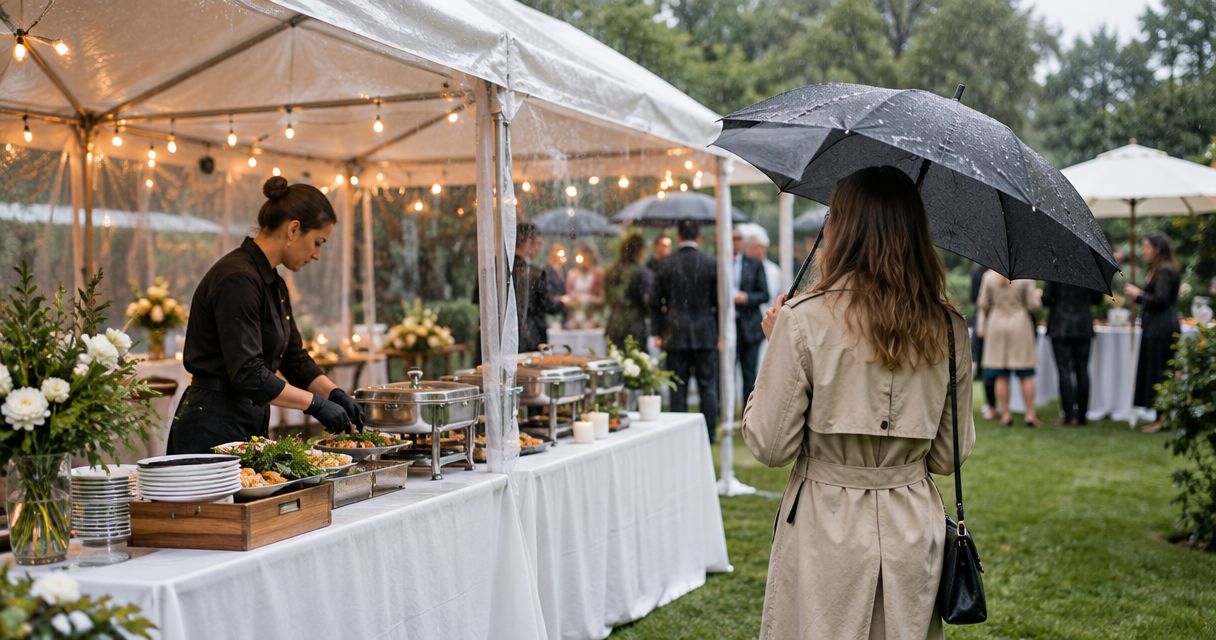
- Weather exposure: Describe sun, wind, rain shelter, and the backup location. A canopy does not replace temperature control.
- Menu requirements: Separate foods requiring hot holding from foods requiring cold holding. Check each dish rather than treating the whole buffet alike.
- Site access: Explain where vehicles unload and how equipment reaches the serving area. Include stairs, soft ground, gates, and restricted access.
- Water and sanitation: Confirm potable water, handwashing arrangements, utensil handling, and wastewater disposal. Restroom access alone does not settle every food-service need.
For your 2026 booking, put these details in writing. A shared site description prevents the caterer and venue from planning for different conditions.
How do you plan BBQ catering without electrical outlets?
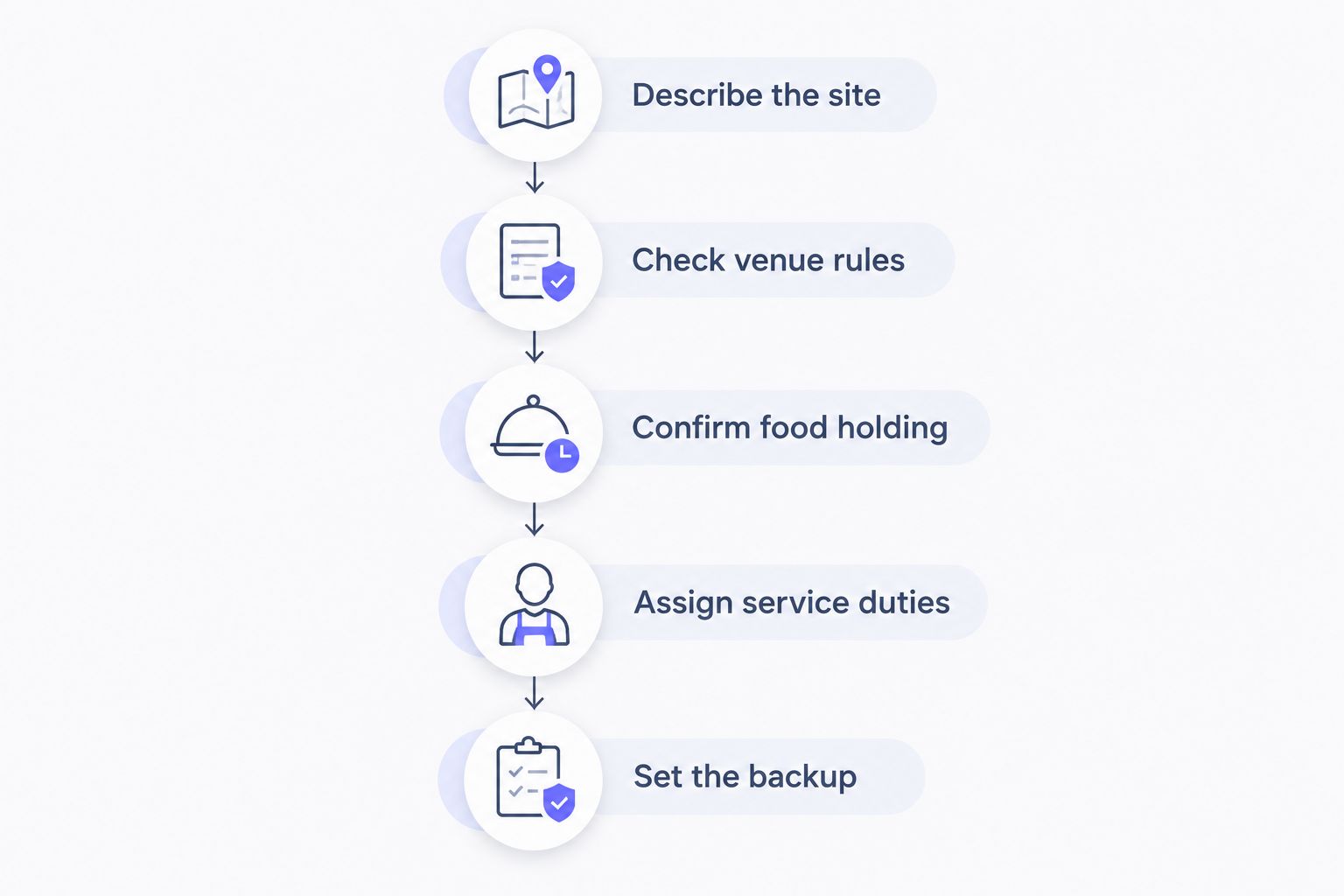
Use this sequence before you finalize the catering arrangement. Approve the site and service method before choosing the buffet layout. That keeps a pretty setup from becoming an impractical one.
- Describe the site. State that there is no usable electricity. Include water access, shelter, unloading conditions, and the planned meal location.
- Check venue rules. Get confirmation about cooking appliances, warming fuel, generators, and the equipment placement process. Ask about applicable health and fire approvals.
- Confirm food holding. Ask how the caterer will maintain and check hot and cold temperatures during transport, waiting, and service.
- Assign service duties. Name who handles replenishment, temperature checks, handwashing supplies, waste, and any equipment adjustments.
- Set the backup. Agree on the response to unsafe weather, delayed service, equipment trouble, or food outside safe temperature limits.
A useful inquiry gives the caterer enough detail to assess the job. Include your event date, venue, guest count, serving schedule, and the explicit statement that no electrical outlets are available.
For Salisbury and Charlotte-area hosts seeking BBQ and soul food catering, Gravytraincatering is a relevant local option to contact. Confirm the no-power arrangement directly; the company's catering description does not establish which off-grid equipment or service methods are available.
Use the catering contact page to describe those conditions before discussing the final menu. Ask for the agreed responsibilities to appear in the event arrangements, including anything you or the venue must supply.
Discuss Your Outdoor Catering Setup
Share your venue, guest count, serving schedule, and lack of electrical outlets.
Does no-power catering also mean no water?
No. Electricity and potable water are separate requirements, and solving one does not solve the other. Your caterer needs an appropriate handwashing and sanitation arrangement even when the food arrives fully cooked.
Ask whether the site provides suitable facilities or whether an approved portable arrangement is needed. Do not count hand sanitizer as a replacement for required handwashing.
Keep drinking water, food-service water, wastewater, and guest restroom arrangements distinct in the planning conversation. Y'all want a good meal together—not a last-minute search for a place to wash hands.
Do you need a generator for outdoor BBQ catering?
Not necessarily. A generator is needed only if the agreed equipment or other event functions require electricity and no suitable supply exists.
List catering needs separately from music, lighting, and other event equipment. A food-service plan that needs no outlet does not establish that the entire event can run without power.
If a generator is proposed, confirm who supplies, places, fuels, and operates it. Follow manufacturer instructions and venue requirements; never put it inside a tent to keep it out of the rain.
Can you leave the buffet out until everyone finishes?
Not without a safe holding or approved time-control plan. An open-ended serving window makes temperature control and responsibility harder to manage, especially when guests arrive at different times.
USDA consumer guidance limits perishable food without safe hot or cold holding to 2 hours, reduced to 1 hour when the temperature is above 90°F. Those limits are not a substitute for the caterer's applicable food-service requirements or an approved written time-control procedure.
For your 2026 gathering, agree on a serving window and a clear close-of-service decision. Ask what happens to unserved food before anyone begins packing leftovers into containers.
FAQ
Can BBQ catering work at an outdoor event without power?
Yes, BBQ catering can work without power when the caterer has suitable hot holding, cold holding, sanitation, and venue approval. Confirm the full plan from transport through cleanup before booking.
What temperature should catered BBQ stay at during service?
The FDA Food Code benchmark for hot-held food requiring temperature control is 135°F or above. The caterer must follow the requirements applicable to the event and check food with a suitable thermometer.
How cold do chilled catering dishes need to stay?
The FDA Food Code benchmark for cold-held food requiring temperature control is 41°F or below. Ask how the caterer will maintain that temperature during transport, waiting, and buffet service.
Are insulated food carriers enough for an outdoor buffet?
Insulated carriers alone do not establish that an outdoor buffet will remain at safe temperatures. Confirm starting temperatures, holding performance, service conditions, and the caterer's temperature-checking procedure.
Can a caterer use warming fuel at a park or pavilion?
A caterer can use warming fuel only where the venue and applicable rules permit the proposed equipment. Get permission for the specific setup rather than assuming a pavilion allows it.
How long can perishable food sit out on a hot day?
USDA consumer guidance limits perishable food without safe holding to 1 hour above 90°F, rather than the usual 2 hours. Catered service must follow its applicable food-service requirements and approved procedures.
Does Gravytraincatering offer BBQ catering around Charlotte?
Gravytraincatering provides BBQ and soul food catering across the Charlotte metro area and is based in Salisbury, NC. Ask directly whether the company can support your particular outdoor venue without electricity.
One last thing
Ask who has authority to stop service if the food is not being held safely. That practical question turns a general promise into a clear responsibility.
A mouthwatering BBQ spread deserves more than a table and a hopeful weather forecast. Before your 2026 event, get the holding method, service responsibilities, venue permission, and backup plan settled—then enjoy gathering your people around the meal.