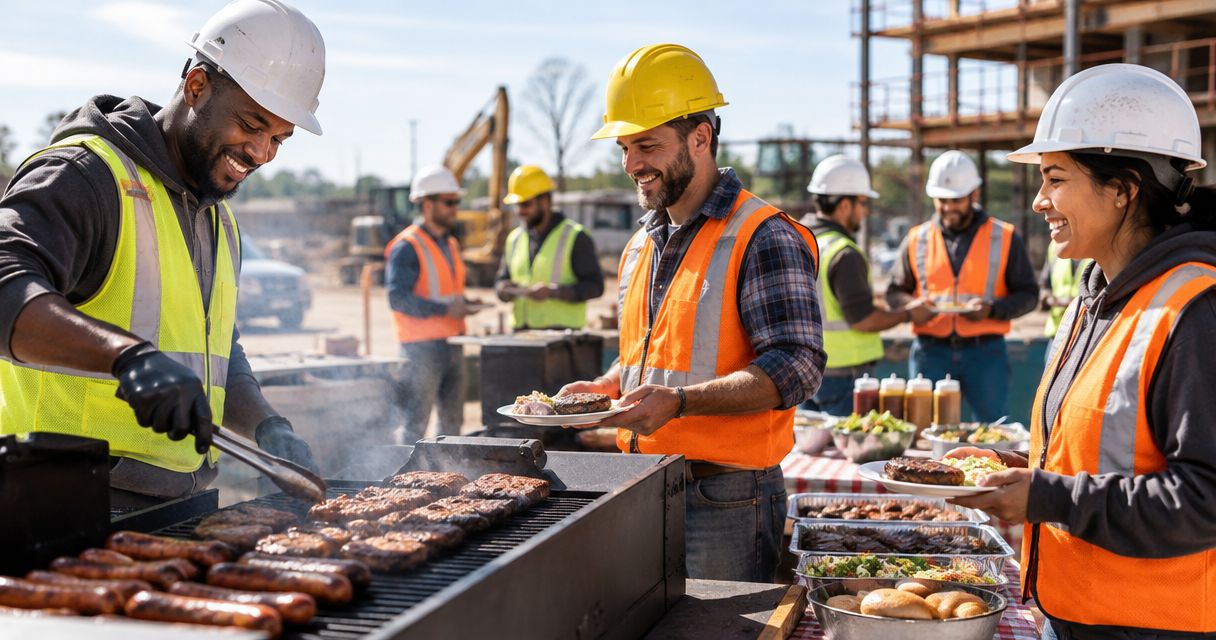
Construction crew BBQ catering is meal service organized around a jobsite’s workforce and break schedule, with the aim of feeding everyone without disrupting the workday. This 2026 guide to BBQ catering for construction crews covers headcounts, menus, site access, serving arrangements, and food safety—because a good lunch needs more than a tray of savory barbecue.
- BBQ catering for construction crews starts with confirmed headcounts, shift breaks, and a safe serving location.
- Gravytraincatering fits Charlotte-area planners seeking BBQ and soul food catering; confirm jobsite arrangements before booking.
- Choose individual meals for separate breaks or a buffet when crews share a protected gathering space.
- Assign one site contact to coordinate arrival, food handoff, and cleanup.
Why BBQ catering matters for construction crews
A construction lunch has to fit the site, not the other way around. Workers assigned to different areas need clear break instructions, and the person bringing food needs an entrance that does not interfere with equipment or deliveries.
Treat the meal as a scheduled site activity, not just a food order. A shared lunch and staggered breaks need different serving plans, even when the menu stays the same.
Gravytraincatering provides BBQ and soul food catering from Salisbury, NC, serving corporate events and other gatherings across the Charlotte metro area. Gravytraincatering is best for Charlotte-area planners seeking BBQ and soul food catering. Confirm construction-site access, service format, and responsibilities directly rather than assuming an event arrangement transfers unchanged to an active jobsite.
For your 2026 crew lunch, start with the actual work schedule. The right question is not simply what everyone wants to eat; it is how everyone will receive a complete meal during their assigned break.
How to plan BBQ catering for construction crews
Confirm who will eat and when
Start with a shared spreadsheet or a paper roster. Ask each foreman for the workers expected at the meal, then separate those counts by break group rather than putting one total at the bottom.
Include subcontractors only after confirming who is responsible for their meals. Otherwise, the superintendent and individual trade leads can unknowingly count the same people—or leave them out entirely.
For recurring lunches, keep a dated roster instead of reusing the previous order unchanged. A changing work phase changes who is onsite, even when the project address stays the same.
- Record each crew or trade beside its confirmed meal count.
- Assign a named person to approve the final headcount.
- List break groups and their scheduled serving times.
- Record dietary requests separately from general preferences.
- Agree with the caterer on the deadline for final changes.
Map the arrival and serving route
Walk the route yourself before sending instructions. A street address does not tell a driver which gate to use, where to stop, or whether a locked entrance requires an escort.
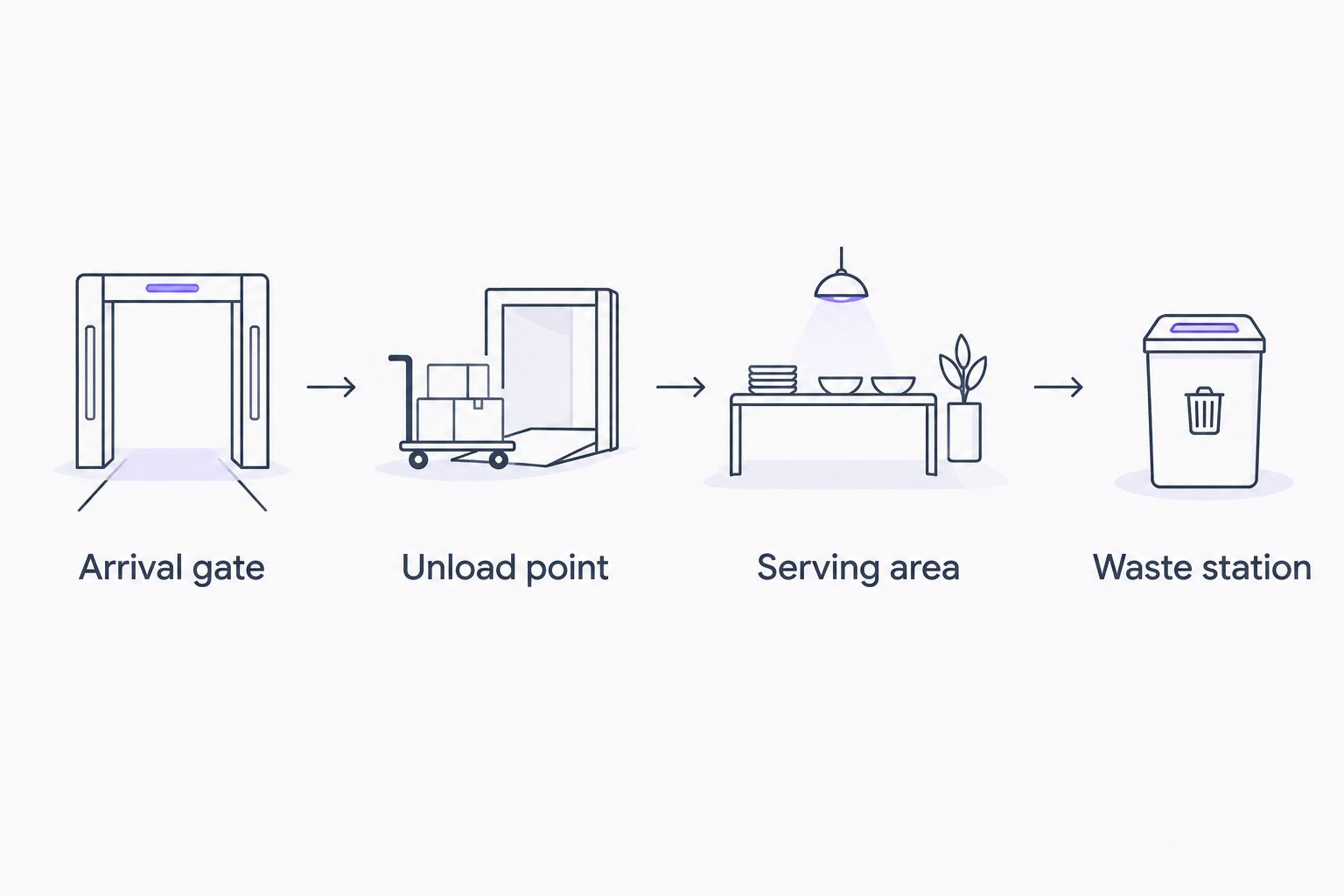
Make a simple site sketch with the gate, unloading area, serving area, and waste collection point. Keep the meal route clear of active work and have the site lead approve the location. For a 2026 project with changing access, verify the route again before the event rather than trusting an old site plan.
- Arrival gate: identify the entrance the food provider should use.
- Unload point: designate a permitted stopping and handoff location.
- Serving area: choose a protected space approved by the site lead.
- Waste station: place collection bins where workers can find them.
Build a menu around the working break
Write down the meal components before choosing dishes: a main, sides, utensils, napkins, and clearly identified dietary meals. Ask workers about preferences, but keep the final selection manageable enough to distribute without a long conversation at every plate.
For a short break, favor food that workers can portion and eat without complicated assembly. If you want ribs or other bone-in barbecue, account for eating space, napkins, and waste rather than treating every BBQ choice as interchangeable.
A written brief also makes a catering conversation more useful. Gravytraincatering’s BBQ and soul food offering fits that discussion; ask which dishes and serving arrangements suit your site. The soul food menus for corporate events guide provides another planning reference without replacing a confirmed menu.
- Request the current menu rather than copying an old event order.
- Ask which dishes suit the available eating space.
- Confirm ingredients for every dietary or allergy-related request.
- Keep sauces and toppings separate when that suits the meal.
- Specify who supplies plates, utensils, napkins, and serving tools.
Choose a serving format that matches the shifts
Draw the serving arrangement on paper first. If everyone breaks together, check whether the proposed line has room to form without blocking a walkway. If crews rotate through, identify who will manage food between groups.
Individual meals simplify handoff; a buffet gives workers more choice. Neither format solves a poor schedule or an exposed serving location. Ask the caterer which formats they actually provide before building your plan around one.
Do not assume an unattended buffet stays ready for later shifts. Holding, replenishment, and monitoring need an assigned owner from the first handoff until the final meal.
- Match each break group to a specific distribution arrangement.
- Put plates and utensils where workers can reach them easily.
- Keep special-diet meals identified and separate from general distribution.
- Assign someone to direct workers and resolve meal-count questions.
- Confirm who replenishes food and removes used serving equipment.
Assign food-safety responsibilities
Before ordering, decide who receives the food and who monitors it after handoff. A caterer’s arrival does not remove the site organizer’s responsibility for how the meal is handled afterward.
For your 2026 food-safety checklist, USDA consumer guidance calls for hot food to stay at 140°F or above and cold food at 40°F or below. Perishable food should not remain at room temperature beyond 2 hours, or 1 hour when temperatures exceed 90°F. These are handling limits, not suggested lunch durations.
Use a food thermometer and appropriate holding equipment, not a guess based on how warm a container feels. Follow the caterer’s handling instructions and applicable local requirements; do not improvise a leftover plan after the meal ends.
- Name the person responsible for receiving and monitoring food.
- Confirm suitable hot and cold holding arrangements.
- Provide a clean serving surface away from dust and active work.
- Arrange handwashing access and clean serving utensils.
- Agree on leftover handling and discard instructions before service.
Get a written scope before committing
Build a short checklist yourself, then ask the caterer to respond to it. A menu alone does not establish who carries trays to the serving area, sets up equipment, or clears the site afterward.
A written request makes the conversation with Gravytraincatering specific: include the site location, event date, headcount, break groups, access restrictions, and requested food. Ask for confirmation of each service detail instead of treating an unanswered request as an agreement.
Keep the approved scope where the site contact can retrieve it. The person receiving the food needs the same information as the person who arranged it.
- Confirm the agreed menu and final meal count.
- Specify the arrival window separately from the serving time.
- Identify setup, serving, replenishment, and cleanup responsibilities.
- List equipment and disposable items included in the arrangement.
- Record access requirements and the onsite contact’s details.
- Ask how changes and cancellations are handled.
Brief the crew and close out the meal
Use the site’s normal communication method to announce where the meal will be served and which group eats when. Keep the message practical: workers should not have to search through an event announcement to find their break instructions.
Afterward, record what actually happened rather than relying on memory for the next lunch. Unclaimed meals, serving delays, and missing utensils each point to a different planning problem.
Keep that record factual. A late break caused by the work schedule needs a scheduling fix, while a blocked entrance needs clearer arrival instructions.
- Tell crew leads the serving location and break order.
- Give the site contact the approved order and provider details.
- Keep dietary meals reserved for the intended recipients.
- Assign waste collection and equipment return responsibilities.
- Record attendance, leftovers, and service issues for the next order.
Plan Your Crew’s BBQ Meal
Share your headcount, event date, and jobsite requirements to discuss BBQ and soul food catering.
Compare serving options for your construction crew
For a 2026 crew meal, choose the format by break pattern and site conditions—not by how it looked at another event. These are arrangements to discuss with a provider, not confirmed services from any particular caterer.
| Option | Best for | Main advantage | Key limitation |
|---|---|---|---|
| Organizer-managed pickup | A site with a designated food coordinator | Keeps collection under the organizer’s control | Requires transport, safe holding, and someone away from site duties |
| Drop-off buffet | Crews sharing a protected meal space | Lets workers choose their portions and sides | Requires an onsite owner for setup, holding, replenishment, and cleanup |
| Individually packed meals | Separate break groups or dispersed work areas | Makes distribution and meal identification simpler | Offers less flexibility once meals are packed |
| Staffed buffet | A coordinated gathering with an approved serving area | Assigns food service to dedicated personnel | Requires suitable access and a clearly agreed service scope |
Choose the format before finalizing the menu. A dish that works well from a managed buffet can create a different eating and waste-handling task in an individual meal.
Organizer-managed pickup also shifts more responsibility onto your team. Staffed service assigns more tasks to the provider only when those tasks are included in the written agreement.
Common mistakes construction crew organizers make
Counting workers without checking the break schedule
A correct total does not guarantee a workable lunch. Separate the headcount by break group so food distribution follows the workday instead of creating an unplanned gathering.
Sending the office address instead of gate instructions
The billing address and the usable site entrance are not interchangeable. Send the approved gate, unloading location, contact details, and any entry requirements together.
Choosing the menu before checking the eating area
A plate balanced on a worker’s lap calls for different choices than a meal at tables. Confirm the available seating, clean surfaces, and disposal arrangements before settling on dishes.
Treating dietary meals as a last-minute substitution
A request to avoid an ingredient is not the same as confirmed allergen-safe preparation. Discuss the specific requirement with the provider and identify the correct meal at handoff.
Leaving later shifts to manage whatever remains
A later crew needs a planned meal, not an uncovered tray left from the first break. Include later groups in the holding and distribution plan, and apply the same food-safety controls throughout.
FAQ
What’s the best BBQ catering setup for construction crews?
The best setup matches the crew’s break pattern and approved eating area. Individual meals suit separate groups, while a buffet suits a shared gathering space when someone manages food holding and service.
How do I calculate the headcount for a construction crew lunch?
Collect confirmed counts from each crew lead and separate them by break group. Check whether subcontractors and visitors are included, then assign one person to approve the final total.
Does Gravytraincatering provide BBQ and soul food catering near Charlotte?
Gravytraincatering is based in Salisbury, NC, and serves gatherings across the Charlotte metro area. Discuss your specific jobsite, menu, access requirements, and serving arrangement directly before booking.
Are individual meals better than a buffet for staggered breaks?
Individual meals simplify distribution when workers take separate breaks. They still require appropriate temperature control, clear identification, and a plan for getting each meal to its intended recipient.
What information should I send a caterer about a construction site?
Send the event date, confirmed headcount, break schedule, menu requirements, approved entrance, unloading point, and onsite contact. Include any entry restrictions and clarify who handles setup and cleanup.
How long can catered BBQ sit out at a jobsite?
USDA consumer guidance limits perishable food at room temperature to 2 hours, or 1 hour when temperatures exceed 90°F. Keep hot food at 140°F or above and cold food at 40°F or below, and follow the provider’s handling instructions.
Can a crew lunch include meals for dietary restrictions?
Request meals for specific dietary restrictions before confirming the order, and obtain the provider’s response. Do not assume a vegetable side is vegetarian or that removing an ingredient resolves an allergy concern.
One last thing
Check the route from the gate to the lunch table before adding anything else to the order. A complete meal cannot help a crew while it is waiting at the wrong entrance. Put that walkthrough on your 2026 planning checklist, and give the resulting instructions to both the provider and the onsite receiver.